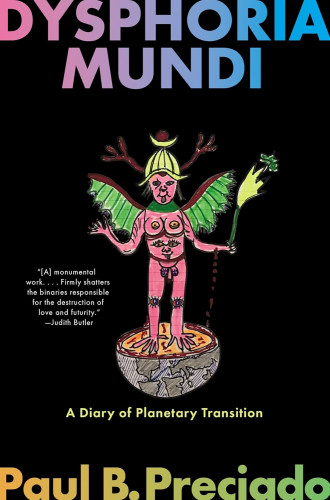
Dysphoria Mundi
A Diary of Planetary Transition
Every so often, a book comes along that knocks me off my heels and radically alters my sense of the world, even my sense of myself. This monumental work by Spanish writer and philosopher Paul Preciado is dysphoric in all the best ways, challenging the conventions of form, language, gender, culture, race, time, politics, medicine, technology, home, society, and everything else that lies in between and beyond.
In chronicling both the personal and global havoc caused by COVID-19, Preciado catalogs a world that was, is, and will continue to be “out of joint,” an ending phrase in most of the book’s chapter titles. Each composition is lyrically breathtaking and unabashed in its critique of what he calls petrosexoracial capitalism, “a mode of social organization and a set of technologies of government and representation that developed from the fifteenth century onwards with the expansion of colonial capitalism and the extension of racial and sexual epistemologies from Europe to the entire planet.” Such a concept may be difficult to grasp for those of us not steeped in critical philosophical discourses. But through each page, Preciado builds an assemblage of historical and present events, cultural critiques, familiar and new concepts, and personal narrative, making this a living and embodied “documentary philosophy”—as the author himself pronounces—rather than a purely theoretical or autobiographical text.
Read our latest issue or browse back issues.
The book begins with a sanitized report of the author’s medical history, revealing a diagnosis of gender dysphoria since adolescence. Preciado—a trans man, in simplified terms—shares that his own dysphoria/insanity of existing psychologically, spiritually, and organically as a gender beyond binary construction is both an indictment of the world as determined by petrosexoracial capitalism and a mode of resistance that is transformative in its own right. In short, dysphoria is both the virus of our current age and the cure ushering forth liberation. For the world’s minoritized bodies, “the present has always been strange, and our future has never been anything other than a series of unanswered questions. . . . We are not mere witnesses of what is happening. We are the bodies through which the mutation arrives and takes place.”
The text is not structured by chapters per se but infused with essays, prayers, and even an aria detailing various aspects of planetary dysphoria. The prayers eschew usual appeals to God and can best be described as inverse litanies to the gods of petrosexoracial capitalism, each concluding with pleas for mercy. Most of the essays begin with a repeating list of binaries (inside/outside, here/there, human/animal, analog/digital, and so on), followed by pages troubling those very binaries. One essay, “The Present Is Out of Joint,” sets the scene for what follows by establishing the way the spread of COVID-19 from Wuhan, China, to the rest of the world dislodged our collective notions of time and space. The phrase “Wuhan is everywhere” appears in most of the essays as “a symbol of a shared condition of immunological vulnerability” and a demonstration of the interwovenness of our planetary ills, such as addictions to phones (what Preciado terms “electronic heroin”), the surveillance of bodies and home spaces (referencing Michel Foucault’s concepts on the subject), and the prescription of opioids as a treatment for pain (conceived as a cure-all for living within a petrosexoracial capitalist society). In this manner, Preciado dismantles the world as it is—or as we would believe it to be—to reveal the disjointedness of modern life.
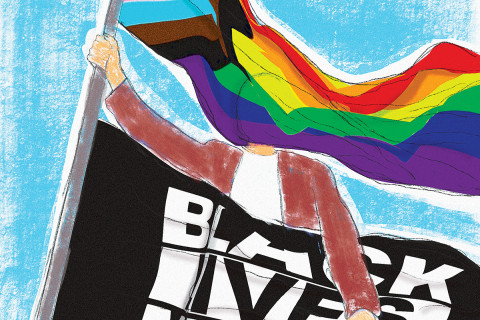
Such revelations emerged from Preciado’s personal experience with COVID-19 shortly after lockdown in Paris and elsewhere. Through a haze of fever and temporary loss of eyesight, Preciado endured a disconnection from his body and senses that brought about what he describes as a mutation, a shift likened both to the planetary mutations of the virus and also the mutations that have sprung up to challenge life-suppressing dysphorias: protests of George Floyd’s murder during the pandemic, the continuing impact of the Me Too movement on women’s freedom from violence, and global solidarities among transfeminist and anti-colonial currents. Preciado was able to make such myriad connections only by going through the experience of profound illness and coming out on the other side with increased clarity about himself, the world, and the possibilities therein. While the pandemic lockdown created greater mechanisms for gender, class, racial, sexual, and societal oppressions on the somatheque—the author’s social and biopolitical term for the body—these forced mutations can also become “chosen mutations” in which “only the sick and the survivors can teach us anything” (i.e., those on the margins of society who are labeled as dysphoric). Toward the end of the book, Preciado offers direct instructions for how we might collectively mutate, including rejecting norms of identity production, questioning prevailing definitions of illness and pathology, creating mutual networks of care and survival, refusing to consume passively, and withdrawing from social and political streams of
violence.
There are many other subjects found within these pages: cars, statues, AIDS, the Notre-Dame Cathedral, reproductive justice, Mars, ChatGPT, libraries, and more. In essence, Preciado provides us with a theory of everything. For the logophile, words such as somatopoliticalumpen and technonecrobiopolitics are a delight for the mind and soul alike. The essays are nothing short of poetically brilliant, indicative of his creative writing prowess. Moreover, Preciado is not shy in his discussion of personal details, including sexual relationships and acts, all of which contribute to the disruption of gender and sexual categorizations. His indictment of religion, particularly of the Catholic Church and its sexual abuse scandals, is cutting but also truthful. At just over 400 pages, this text demands serious time and focus.
And yet, as soon as I finished it I wanted to read it again—and I will. For those yearning for a deeper understanding of our world as it is—dysphoric and mutating—and for a bit of challenge and insight as to how we begin making collective mutations toward liberation, this book is vital reading.
This review was produced in partnership with the Narrative Project and Sacred Writes.