Antisemitism, an American Tradition
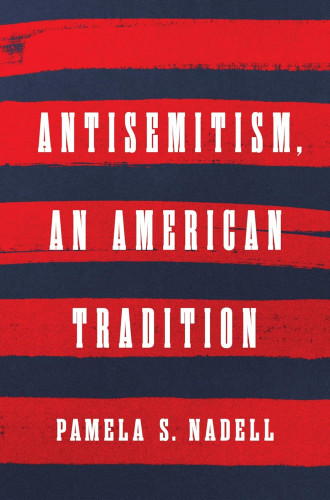
Many of us probably don’t imagine the United States as a nation in which a tradition of antisemitism reaches back to the original 13 colonies and has emerged in every generation. In her new book, historian Pamela Nadell carefully documents the history of discrimination, conspiracy theories, and violence against Jews in our republic, as well as the resilience of Jewish Americans in resisting and organizing against antisemitism, both at home and abroad. This highly readable book offers an excellent introductory text for undergraduates, theological students, clergy, and adult study groups.
Nadell defines antisemitism largely with historical and contemporary examples rather than abstract theories. The term was coined by Wilhelm Marr in 1879 to distinguish the “modern racial basis of Jew hatred” from traditional Christian anti-Judaism. The author defines it as “Jew hatred” and cites “many episodes of anti-Jewish animus” in US history. She also documents the “social antisemitism” that excluded Jews from private educational institutions, housing, social clubs, and a wide variety of professions or reduced their numbers through quotas, especially in higher education. One of the distinctive aspects of this book is the way the author (who holds a chair in women’s and gender history at American University) foregrounds the acts of American Jewish women as not only victims but also resisters and organizers against antisemitism.

Read our latest issue or browse back issues.
Nadell demonstrates how movements and acts of antisemitism became occasions for Jews to create new institutions that both opposed discrimination and helped to create the most vital Jewish diaspora community in world history: B’nai B’rith, the Anti-Defamation League, the American Jewish Committee, the American Jewish Congress, the Jewish Publication Society, local synagogues, and other organizations worked to educate the public about the deceptions and harm of antisemitism and the history and contributions of Jews and Judaism to civilization. Many of these organizations also campaigned to protect Jews anywhere in the world where they were oppressed.
Antisemitism, an American Tradition also recounts how Jew hatred has emerged on both the political right and left in a wide variety of organizations, reaching even to the ranks of the US Congress and the State Department. For some antisemites on the right, Jews are associated with communism and radical left-wing politics. For some antisemites on the left, all Jews are categorized as Zionists and blamed for the plight of the Palestinians, regardless of their political stance toward the state of Israel. Others have blamed Jews as profiteers of international capitalism or as members of grand conspiracies to undermine White supremacy and drag America into foreign wars.
Some readers of this publication may be surprised to discover its place in this history of discrimination. “In 1936,” writes Nadell, “The Christian Century, a vehicle for mainline Protestantism, preached the necessity for Jewish conversion” to Christianity (“Tolerance is not enough!” July 1, 1936). Then in 1967, the magazine published an article by Willard G. Oxtoby that “compared Israel’s militancy to that of the Nazis and its conquest of Old Jerusalem to the Anschluss, Germany’s incorporation of Austria into the Third Reich” (“Christians and the Mideast crisis,” July 26, 1967).
Some may be shocked to read how prominent American figures like the industrialist Henry Ford were crucial to the wide dissemination of anti-Jewish conspiracy theories in the 1920s. Ford published The Protocols of the Elders of Zion, an anti-Jewish work of plagiarism and lies, in his newspaper, The Dearborn Independent, as part of a series entitled “The International Jew.” In 1923, Hitler had Ford’s series of articles translated into German.
Others may be surprised by activist Daniel Berrigan’s speech against the state of Israel for the Association of Arab-American University Graduates in October 1973. Berrigan’s “words riffed on themes of Jewish deceit, cunning, cruelty, and power,” writes Nadell. “This was antisemitism gussied up in a new cloak.” The century later reported on how Catholics, Protestants, and Jews criticized Berrigan’s antisemitism (see “Berrigan and his critics,” January 16, 1974).
Considering expressions of antisemitism in the context of the Israel-Palestine conflict, Nadell argues that there is a fine line between political criticism of specific policies or acts of the state of Israel and the sort of demonization of Israel that trades in anti-Jewish tropes and stereotypes. century readers involved in the debate around the war in Gaza will be helpfully instructed by the need to guard criticism of the Israeli government’s conduct of the war from anti-Jewish bias. Just as it is wrong to blame all Muslims and Arabs for the horrific acts of Hamas, so it is wrong to blame all Jews for the loss of precious lives and the destruction of Gaza. A further question among these debated issues today is whether all forms of anti-Zionism are necessarily anti-Jewish.
At a time of deep polarization in American political life, teaching about the history of American antisemitism can make us better aware of how racism and xenophobia aren’t merely a matter of hurt feelings and perceived grievances. Because of antisemitism in the US State Department in the 1930s and ’40s, hundreds of thousands of European Jews seeking to escape from the Nazis’ racial genocide were denied entry to America. Considering incidents like the 2017 Unite the Right rally in Charlottesville, Virginia, the 2018 massacre of 11 people at the Tree of Life Congregation in Pittsburgh, and others, it seems that America has a significant social and political problem with antisemitism—one that is becoming worse. Congregations and church-related institutions can be places where we learn about the history of Christian anti-Judaism and its modern forms of antisemitism—and how to resist them in our speech, acts, and political engagement with the issues of our times.