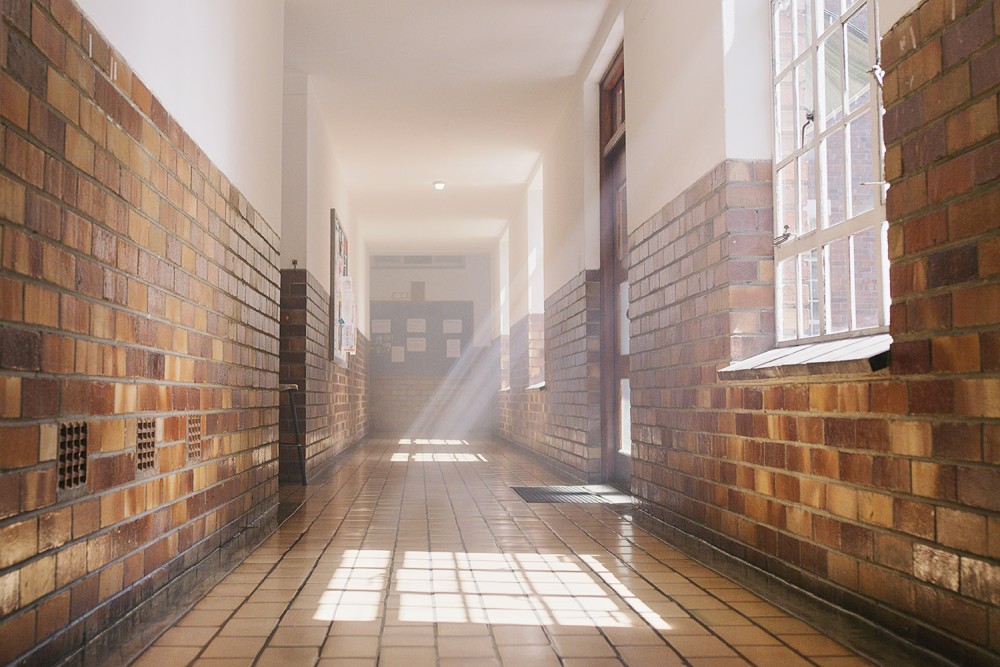
Much of my upbringing took place in Sunday school rooms. We spent a lot of time at church when I was growing up in the 1970s and ’80s. I was baptized in one United Church of Christ congregation, confirmed in another, and spent some time at my grandmother’s Evangelical Free church as well. In all three churches, the Sunday school rooms were off corridors in a dedicated wing. In my memories, those rooms and corridors are all about the same. The floors are speckled tile—possibly asbestos, I realize now—with a vinyl baseboard. The walls are cinder block painted in pale yellow, blue, mint green, or off-white. A rug designates the space for the Bible story circle time, which includes the beloved felt board for illustrating the stories with people and animals and a rainbow for Noah’s ark. Chairs and tables are placed on the tile floor for crafts and activities. Posters from the denominational curriculum hang on the walls, depicting little children gathered around Jesus. There are Dixie cups for grape or apple juice, served with animal crackers or, later, Goldfish. Many of my colleagues have strikingly similar memories, right down to the particular smell, a mix of the paint on the cinder blocks and the cleaning solutions used on the floors.
We heard and memorized scripture in those rooms. We made endless crafts—tangentially related to the day’s Bible verses—of Popsicle sticks, paper plates, pipe cleaners, tissue paper, glitter, and glue. We sang songs, learned hymns, memorized the Gloria Patri and the Doxology and the Lord’s Prayer. We knew that Jesus loved us. We knew that here is the church and here is the steeple. We dressed for Christmas pageants in those rooms and wore our Easter finest after weaving Palm crosses the week before. After class we’d proceed to the sanctuary to sit with our parents or grandparents during the worship service.
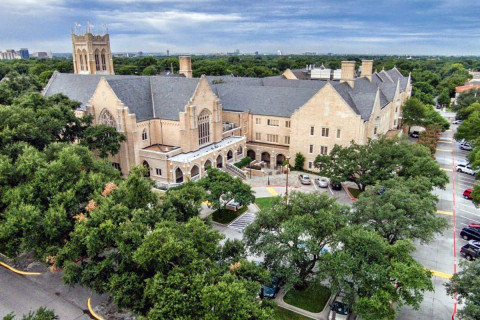
These Sunday school wings emerged in the 1950s and ’60s in response to the baby boom. At my grandmother’s church, the 1920s-era stone building was equipped with a Sunday school addition by the 1950s. The church where my parents were married was a newly planted congregation of the newly merged UCC, built in the late 1950s. Not even a decade later, more space was needed. My father served on the capital campaign committee to raise funds for the Sunday school wing, which was complete by the time we were born. The UCC church we joined later, when we moved across town, had relocated from a downtown location to a growing neighborhood, also in the late 1950s. This building was constructed with the Sunday school wing already included.