We sat in the hallway in a couple of plastic folding chairs. My patient’s mother and teenage brothers were haggard from 48 straight hours spent in the hospital, but they repeatedly declined my offer of coffee or tea. (I’ve changed some details in this story to protect their privacy.) For the last 20 minutes, the mother and I had alternated between a discussion of her hope in a miracle for her ten-year-old daughter and long periods of silence broken by the ping of the elevator and the beeping of monitors. I was just about to ask again if I could get them anything when I saw one of the residents step off the unit and head in our direction. For a moment we locked gazes. I knew exactly what he was going to say. I stood up so he could take my chair.
“I’m so sorry to have to tell you this, but your daughter’s heartbeat is extremely erratic,” the doctor began, looking at my patient’s mother. He explained that soon her heart would stop. “If it’s your wish,” he said, “we will begin chest compressions to see if we can restart her heart. But I want to be very clear with you—the outcome will not be changed. I’m so sorry, but your daughter is going to die no matter what.”
Read our latest issue or browse back issues.
My patient’s mother looked steadily at the doctor as her two sons fidgeted in their seats and stared at their mom. She took a deep breath and rubbed her face with her hands.

As the silence lengthened, a wave of powerful emotion surged over me—a mix of pain, regret, guilt, and desperation—and I knelt beside my patient’s mother to be eye level with her. “I know this entire situation is unimaginable. A nightmare. And like the doctor said, if you want them to try to resuscitate your daughter, they will.” I paused for a moment, weighing the wisdom of my words, then plunged on. I told her that some families decide they would rather let their loved one die a natural death—they believe that when the heart stops, it is God’s will and God’s timing. “We respect your beliefs and values,” I said. “But I want you to know, as a chaplain, that I have seen many families choose not to try to resuscitate their loved one not despite but because of their faith.”
My patient’s mom gazed at me, tears filling her eyes. She shook her head slowly. “I could never give up on my daughter.” She turned away from me and fixed her gaze on the doctor. “Do everything, please. Do everything.”
Slowly, the doctor nodded. After a moment, I did too, wondering if his heart was sinking as completely as mine. With a long exhale, the doctor said quietly, “We will,” and walked back into the patient’s room. My patient’s mom dropped her head into her lap and her oldest son placed his head on her shoulder. Finally, she stood up, and the four of us followed the doctor back into the unit.
As my patient’s family congregated outside of her room, I went to get them some cups of water, wanting a moment alone. I could not imagine the grief of losing your child, especially one whose entire life lay ahead of her, but I felt a searing anguish at the knowledge of what was to come.
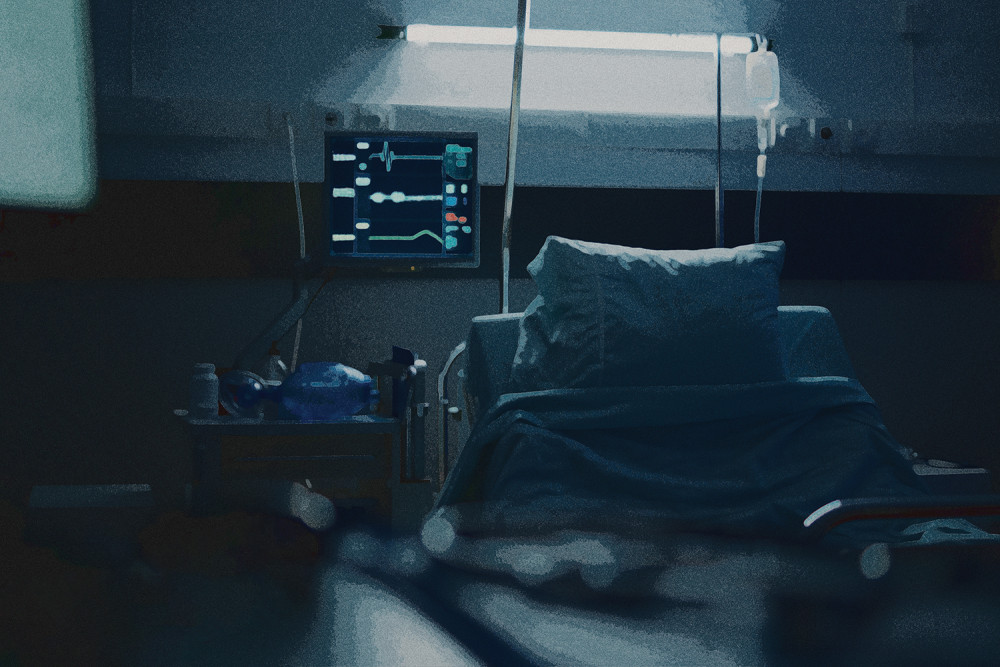
Returning to the room, I watched as my patient’s bedside grew crowded with residents and nurses donning yellow gowns and purple gloves, readying themselves for the heartbeat they knew would stop, the brutal intervention they were obligated to perform but knew, without a doubt, would fail.
For the next half hour, the child life specialist and I stood outside the room next to our patient’s mom. We watched as the numbers on the monitor began to fall. We watched as the doctors and nurses stepped into place, waiting, the medical fellow who was first in line to begin the chest compressions grimly ready. We watched as the monitor flatlined, the beeping began, and the clinicians quickly but calmly jumped into action. We watched as the minutes ticked by until the organized frenzy stopped with a shocking, heavy, unmovable finality, and the medical team trickled, exhausted, out of the room. I made eye contact with the resident. We steeled ourselves to deliver the news.
As I fell into bed later that night, utterly drained, what felt like the most tragic part of the day’s events was not the passing of a life nor even the violent way it had ended, but the fact that despite all our foreknowledge that she would die, my patient’s family had not said goodbye.
As medical technology has advanced, the dying process has evolved. Disease courses that a few decades ago would have resulted in certain death are now prolonged by artificial life support and other extreme interventions. These medical advances often do not increase one’s life so much as they drag out one’s death. The line between life and death, a natural end and artificial continuation, becomes increasingly blurred.
When patients with zero chance of a meaningful recovery are kept full code, necessitating chest compressions if the heart stops, the dying process often becomes traumatic, for both the medical providers and the patient’s loved ones. Instead of spending quality time with their loved one, engaging in memory making and legacy work, families watch, horrified, as their faith in futile interventions results in blaring monitors and broken ribs. In these futile situations, even if the heart is restarted, the resuscitation accomplishes nothing more than a repeat of the horror scene, a cycle of codes that leave the medical providers and families in growing despair until these last-ditch attempts fail. I wonder frequently about what such violent interventions do to the minds and souls of the clinicians, how it must shape their sense of vocation to experience death not as a natural process but as the carnage of their own failed efforts to save.
Such desperate and desperately tragic scenarios are known in the medical world as “futility disputes,” and in my work as a hospital chaplain, I have witnessed their drama play out with a kind of Groundhog Day heartbreak. The medical team shares that they’ve reached a point where life-prolonging medical interventions can no longer reverse the patient’s disease course. The family states that they want to try more medications, more therapies, in an attempt to stave off the inevitable. Eventually, the patient gets an infection or enough organs fail that their heart stops, catapulting the doctors into resuscitation efforts. The family watches from a distance as their loved one dies violently, surrounded by strangers.
Sometimes families make this decision to “try everything” because they genuinely believe there is hope despite what medical science is telling them. But sometimes they make the decision because to choose nothing over something would feel like giving up. In those situations, guilt, not hope, becomes the motivator.
Futility disputes have many commonalities: frustrated clinicians, upset families, numerous family meetings to determine “goals of care,” and an abundance of distress all around. There is moral distress for the clinicians, as they consider how the futile treatments will harm, not heal, their patients, and emotional distress for the family as they feel unheard and unvalued. Every seasoned clinician has heard, “You just need the hospital bed for someone else.”
Above I used the word faith to describe the relationship of many families to artificial life support. That feels to me like the truest characterization of the profound trust I often see placed in extreme life-sustaining interventions. Ironically, research has shown that the people who are most likely to put their faith in artificial life support are overwhelmingly the most religious. Sometimes those families insist on medically futile interventions because their faith practice requires it (as is often the case with Orthodox Jewish patients and families), and sometimes they insist on it because their religious beliefs compel them to hope, to have faith, and to choose life against all odds.
Scripture tells us at least three things about death. First, it tells us that death is wrong. God’s original design for creation was perfect, joyful, and everlasting life in union with God’s trinitarian self and with each other. It is only because of humanity’s rejection of God in the garden of Eden that death became introduced to the world. Throughout scripture, God makes it clear that death is wrong, an effect of a fallen creation, and that grief is an appropriate and even necessary response. (Recall the widow’s son in 1 Kings 17, David grieving for Absalom in 2 Samuel 18, and Jesus’ tears for Lazarus in John 11.)
Second, scripture tells us that death is both a temporary physical state and a necessary spiritual state in order to obtain everlasting life. It is only by physically dying that we can enter into God’s kingdom, and it is only by spiritually dying that Christ can begin his work of new creation in us, sanctifying us with the Holy Spirit. Death was not part of God’s original design, but it becomes the redemptive means by which we achieve true and final union with God. Crucially, human beings are not the pioneers here—in the incarnate person of Jesus, God lived, died, and rose again as the “firstborn of creation” (Col. 1:15).
Third, scripture tells us that we are to love one another as Christ has loved us. This means our love for our neighbor must be modeled after Christ’s own self-sacrificial love. It seems to me that another way of describing this scriptural mandate is this: Sometimes loving one another requires a kind of dying. We are to “lay down our lives” for our friend, as Christ laid down his life for us (John 15:13). We are to wash each other’s feet, as Christ washed his disciples’ feet. We are to put the good of our neighbor ahead of our own good, not out of masochism but from an embodied understanding of a deeper good, a deeper reward, a deeper life that is to come. This kind of painful self-giving, this sacrificial Christlike love, can undeniably become a form of death.
Given these three scriptural truths, might the Christian predilection toward pursuing futile medical treatment be understood as ironic? We testify to the meaning of our loved one’s life by prolonging their death. We show our love for them by making decisions that ultimately leave them alone in their final hour. We claim to believe in something higher than medical science—namely, God—yet we put our faith in futile medical technologies, ultimately declaring their supremacy. Perhaps the deepest irony lies in the difficult truth that when we deny our loved one a natural death, we eschew our own responsibility to live out a deathly kind of love.
To some, the idea that a robust Christian theology might be viewed as incompatible with futile medical interventions may seem profoundly cruel. So let me acknowledge a few things. There are myriad reasons why a thoughtful Christian may, with deep spiritual integrity, choose to pursue extreme artificial life support for their loved one—perhaps the patient requested such interventions, or perhaps the goodbye is incomplete and, for various reasons, necessitates more time. Not every Christian may read scripture with my hermeneutic, and certainly other conclusions about life, death, and love can be extrapolated from its pages. The perspective I am articulating is simply my own, drawn from my interpretation of scripture and the things I have witnessed in my work as a palliative care chaplain. My aim in writing this piece is not to try to convince readers to reach the same conclusions; it is to try to make imaginable a narrative in which opting for a natural death over extreme end-of-life measures can be a beautiful and powerful manifestation of Christian love.
In such a narrative, we accept and make peace with God’s mysterious timing rather than putting our faith in artificial life support. We self-sacrificially give our loved one back to ultimate, self-sacrificial love rather than clinging to them past their time. We trade hope in miraculous interventions with hope in miraculous grace—for our loved one in their final hour, and for ourselves as we navigate the world without them. It feels to me that good neighborliness—the kind that Jesus calls for, the kind that the Jewish philosopher Emmanuel Levinas posits as the ultimate ethical obligation—must have at its center the sacrificial love for the other that makes true relationality possible. Put another way: To truly love our neighbor, whether a spouse, a child, or a friend, is to love them back to God, always and especially in the sacred moment of their death. This is the narrative that I would want for my own life when my time comes, and it is the narrative I pray I’ll have the grace to follow if or when I am ever in the excruciating position of making medical decisions for my loved ones.
Death is horrific. It is wrong and wrenching and bewildering, as anyone who has experienced it well knows. Those of us whose lives are oriented around the Christian narrative of creation, fall, redemption, and new creation, have the power and even the obligation to declare death wrong, a deviation from God’s original intent. Yet this same narrative that compels us to recognize the evilness of death also invites us into another reality.
The tension between eschatological hope and present suffering is one I feel keenly every day in the hospital. Sometimes, the story of Easter resurrection gives me the strength to hope even while knee-deep in cases that would break the hardest of hearts. Other times, not even the most powerful sermon or beautiful scriptures can move the cinder block of grief and doubt I feel as I watch children die. This is a holy oscillation. “He will wipe the tears from all faces,” says the minister John Ames in Marilynne Robinson’s Gilead, paraphrasing Revelation 21:4. “It takes nothing from the loveliness of the verse to say that is exactly what will be required.”
It takes a kind of long-suffering love, a costly love, to accept the death of a loved one even as we cling to the truth of death’s ultimate demise. But when all the medical treatment in the world cannot resurrect our loved one, the Christian promise is that medical futility is not spiritual futility, and medical resurrection is not spiritual resurrection. There will come a day when all creation will be made new and the suffering of this present time will not be worth comparing to the glory that shall be revealed. Until then, we have a choice: to deny the death that will eventually come for us all, or to surrender to the face of love—a face that suffers with us, that tasted death for us, that will one day wipe the tears from all faces because he himself is a man of sorrow, deeply acquainted with grief.