

A rabbi’s unlikely path
Angela Buchdahl writes honestly about her accomplishments, her hardest moments, and the routine difficulties of showing up in Jewish spaces with a Korean face.

The bad king
Nimrod is the biblical archetype of the corrupt leader obsessed with his own power.

Terrible leaders of the Bible
When I remember the story of Jonah the insufferable prophet, I am filled with a strange hope.
What do people in their 20s want from church?
Churches try all kinds of tricks. But new research indicates that the answers are surprisingly traditional.

The great man theory is poison for the church
The problem isn’t just that it exists. It’s that so many ministers fall for it.

Cultivating Christ-like compassion
We may feel compassion in our guts, but we learn it by practicing empathic solidarity.
Multigenerational rage, holy listening, and the unveiling of another way
A conversation between Parker Palmer, Stephen Lewis, Matthew Wesley Williams, and Dori Baker about the book Another Way
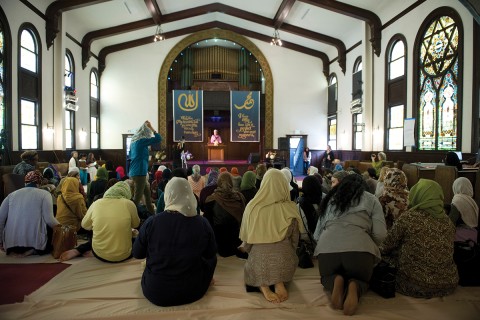
A woman’s place—at the mosque
How American Muslim women are transcending barriers to leadership.
A radically new vision of mainline church leadership
Helping people think differently in changing times
James Comey didn’t write a tell-all. He wrote a handbook.
What does ethical leadership look like?

How millennials gather
Peer-led discussions among young Muslims, Christian experiments in communal living, and pop-up Shabbat meals embody common yearnings.
The emotional wisdom of irrational Christians
Ken Evers-Hood applies behavioral economic theories to Jesus—and the people who follow him.

You knew about weakness before you were ordained. Yet something made you get out of the boat and try to walk.
"Narcissists can be inspiring. Whether they are creative or destructive depends on their philosophy."

What goes on in the mind of a leader who tires of building consensus and just strives to get things done?
Many times we are working with church structures of a different time. I have seen churches with 50 people attending on Sunday morning, and they maintain 12 committees. There may have been a lot of retirees in the church, so we have committees who meet in the day. Or there might have been a lot of people without children, so everyone meets at night—on a different night, to ensure that the pastor is at every meeting.
For mainline pastors, the Driscoll saga—the conflict at Seattle’s Mars Hill Church leading to the resignation of superstar pastor Mark Driscoll—can seem like a number of things: an entertaining but irrelevant sideshow, a distraction from the real work of God’s kingdom, or the long-overdue fall of someone whose theological views and ideology are so different from ours. We feel so distant from Driscoll and what he stands for that we can almost watch with bemused smiles.
And it’s just this sense of distance that might keep us for seeing this situation the way we should: as a cautionary tale.
This temptation will always remain when we are willing to blindly benefit from and represent a system that is working well for us, without the concrete concern for others that are silenced or stigmatized by that very same system. In the name of making a difference, we can actually begin to help the system be sophisticated in its ability to point to its “change makers” (even though they are merely exceptions to the rule) as evidence of its commitment to anti-oppression.
