Books

Why the South Bronx burned

Bench Ansfield argues forcefully that the arson wave of the 1970s was about racism, capitalism, and the insurance industry.

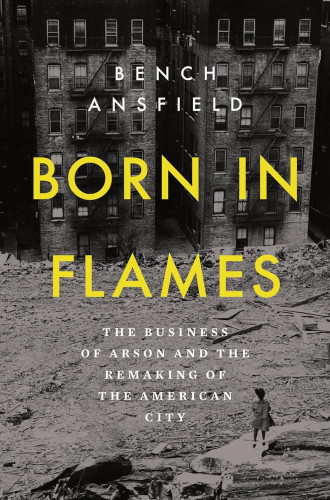
Born in Flames is a powerful retelling of the arson wave that overtook the South Bronx in the 1970s. Bench Ansfield offers a corrective history by providing an alternative to the well-worn narrative of “racial pathology” that left “the vague impression that Bronxites burned down their own borough” in the wake of the social upheavals of the 1960s. Rather than indulging a story of racial pathology, Ansfield forcefully argues that the Bronx arson wave of the 1970s was a foreseeable if regrettable conclusion to the logics of racial capitalism that define what they call the American finance, insurance, and real estate (FIRE) industries.

Running parallel to the well-known history of mortgage redlining, Ansfield argues, was the practice of insurance redlining. Following the riots of the 1960s, insurers in cities across the United States began either to offer subpar, single-­line coverages or to withdraw completely from areas deemed “riot-prone.” Riot-proneness, however, was merely a proxy for race, meaning that communities of color were disproportionately impacted by the withdrawal of insurers from urban areas. In a stark illustration, Ansfield recounts how “on August 19, 1967, Philadelphians awoke to discover that their city’s insurance had been canceled. That morning, the Inquirer reported that the Philadelphia Housing Authority (PHA), the largest landlord in Pennsylvania, had found itself suddenly uninsured.”

To address the lack of coverage, states created fair access to insurance requirements plans. FAIR plans (which still exist) were administered by “public-private insurance companies,” explains Ansfield, companies that were “backed by the federal government and overseen by individual states.” The plans provided poorer coverage at higher rates to homeowners in high-risk insurance pools, including those living in “riot-prone” areas. To give insurers an incentive to participate in these high-risk pools, the federal government offered FAIR plans reinsurance, which is essentially insurance for the insurance company. This helped to diffuse financial risk from insurance losses across space and time.


In the Bronx, the high-premium, low-coverage combination offered by the FAIR plans, particularly those offered by the New York Property Insurance Underwriter’s Association, had disastrous consequences: It became more expensive for landlords to maintain a property than to abandon it. In Ansfield’s retelling, this insurance gap—that is, between the market value of a property and its total insurance payout—created a perverse incentive for landlords to burn down their own buildings. Such was the financial reality that led to the development of arson rings in the city that torched tenements in order to collect insurance payouts.

Although Ansfield is unable to determine just how common these landlord-­led arsons were—due in part to how difficult it is to identify arson in general—they suggest it was a significant subset of the Bronx tenement fires. To bolster this argument, they point out that organizations like the NYPIUA eventually admitted that the insurance gap seemed to incentivize arson fires. What’s more, publicly owned housing, such as that operated by the New York City Housing Authority, experienced drastically fewer fires. Ansfield makes this startling observation:

The most decisive factor determining a given building’s susceptibility to arson was whether it was owned by the state or private enterprise. . . . As the Bronx DA reported, “When the profit is taken out of arson there are no fires.” . . . It is difficult to imagine a more damning indictment of the private market for rental housing.

Ansfield’s observations tell a larger story about the risks of the financialization and racialization of capital flows in the United States and across the globe. While global financial markets enable the distribution of risk across space and time, they can also come at a great cost. In the case of the property insurance schemes at the heart of Ansfield’s work, the predominantly Black and Brown Bronx residents who were violently forced out of their homes shouldered a massive burden, while insurers and property owners came out largely unscathed. When it became clear that insurers and state officials would need to be held accountable for the reckless underwriting and insurance practices fueling the fires, it was residents themselves who undertook the task of mobilizing to enact the social and political changes that would bring the arson wave to a close by the end of the decade.

Beyond the story of loss and destruction wrought by the Bronx arson wave of the 1970s, Ansfield tells a more powerful story about the strength and ingenuity of Bronx residents who not only survived this period but also fought passionately and creatively for the safety of their communities. Bronx residents were neither agents of their own destruction nor passive victims of the greedy machinations of landlords and financial capitalists; they were active in the fight for their own futures. Community organizations, clergy, educators, and activists were all involved. They created art, formed tenant unions and associations, conducted experiments in urban homesteading, and pressured state and local officials to take action. Ansfield makes a significant contribution to our understanding of the period by bringing Bronx residents’ histories to the fore and reminding us that there is much to be learned if only we pay attention. 


This review was produced in partnership with the Narrative Project and Sacred Writes.

Brooklyne Oliveira

Brooklyne Oliveira is a doctoral student in religion at Princeton University.

All articles »