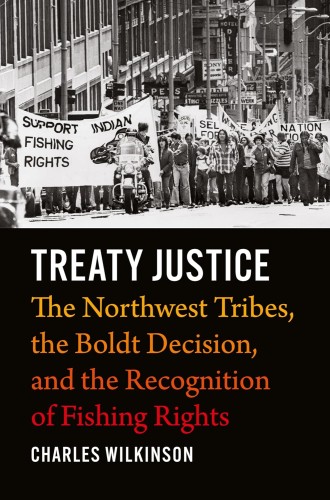
Treaty Justice
The Northwest Tribes, the Boldt Decision, and the Recognition of Fishing Rights
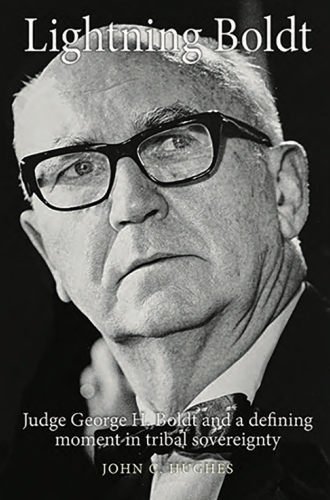
Lightning Boldt
Boldt and a Defining Moment in Tribal Sovereignty
Last year marked the 50th anniversary of one of the most significant court cases in the long and troubled relationship between the United States government, Indian tribes, and the states. In a sweeping decision that was comparable in impact to Brown v. Board of Education, federal judge George H. Boldt decided for a group of 20 tribes and against the State of Washington. Some 130 years earlier, in the winter of 1854 and 1855, Indian fishing rights had been reserved by the tribes in treaties in which Washington territorial governor Isaac I. Stevens acted on behalf of the federal government. In Boldt’s 1974 decision, he declared that those treaties were still “the supreme law of the land,” as Article VI of the Constitution states. He recognized the tribes as sovereigns in the treaty negotiations and stated that their treaty-guaranteed fishing rights could therefore not be impinged upon nor abrogated by the State of Washington. The Boldt Decision, as it came to be known, was upheld by the US Supreme Court five years later in a 9–0 decision.
Two recent books illuminate the history and background of the Boldt Decision. Charles Wilkinson, who died last year, was a widely respected legal historian familiar with federal Indian law and the ongoing struggle of Northwest tribes to assert their treaty-reserved fishing rights. He was also familiar with many of the combatants in the “fish wars” of the 1970s and ’80s that took place on the rivers of western Washington and included the United States v. Washington case tried in Boldt’s federal courtroom in Tacoma. Wilkinson previously wrote about this ongoing conflict in Messages from Frank’s Landing (2000) and Blood Struggle: The Rise of Modern Indian Nations (2005). His new book, Treaty Justice, provides a compelling description of the case, including the complex history that led up to it and the surprising aftermath that continues to affect the lives of Native and non-Native northwesterners today.
Wilkinson’s book—completed shortly before his death in 2023—is a response to a 2013 request from Billy Frank Jr. (Nisqually), a major proponent of Indian fishing rights, for a readable and accessible history of the Boldt Decision for both tribal members and the general public. The result is a definitive history that is unlikely to become outdated.