

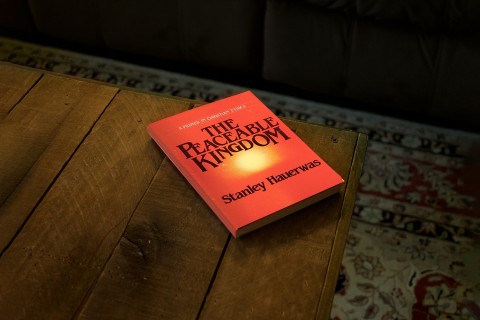
Willimon and Hauerwas’s out-of-season words on pastoral care
Pastors coping with the pandemic need our encouragement, not our carping.
Pastoral care is part of Christian formation
A response to Will Willimon and Stanley Hauerwas

Christian peacemaking and the role of forgiveness
Seeking justice is critical. Is it enough?

Hip-hop artists Sho Baraka and Propaganda flip the script
Stanley Hauerwas says good theological writing makes the familiar strange.
Still resisting Constantine
According to Reformation scholar Jason Mahn, the birth of Christendom was a sort of Fall.

The opportunity Stanley Hauerwas missed
Heirs to John Howard Yoder's legacy have to grapple with his theology in light of his sexual abuse. Hauerwas’s recent response isn’t enough.
Nussbaum, a psychiatrist who labels himself a “bad Catholic,” delves with religious fervor into the mystery of his calling to serve people who suffer. Guided by mentors like Basil of Caesarea, Hildegard of Bingen, and Stanley Hauerwas, he envisions medical care as a precious craft honed by the development of virtue.
Longtime Hauerwas readers will not be surprised to hear that his new book is maddening—nor that some of the most maddening aspects are also the most rewarding.
Like Willimon and Hauerwas, Donald MacKinnon began with Philippians 2.
We need the spiritual agility to recognize counter-hegemonic "citizenship in heaven" whenever and however it becomes flesh.
Resident Aliens, a work of theology, was put to use as applied sociology. The description of life in the Christian colony became, paradoxically, a formula for success.
A funny thing happened on the way to the church-as-polis: I can now imagine being a resident alien and invested in the state, in all of its glorious failing.
Resident Aliens helped convince a generation that there is no Christian identity apart from the church. But where exactly is Hauerwas and Willimon's "adventuresome" church?
I once actually was a resident alien. I wonder if Hauerwas and Willimon have any clue what it means to occupy that space.
Denigrating "social activist churches" was central to Hauerwas and Willimon's agenda. Yet Resident Aliens revived social gospel arguments.
The image of a resident alien offers an important biblical corrective. But it isn't the only such image we need.
It is disingenuous to deem ourselves alien to a culture and society we benefit from—a culture and society we created.
I understand Resident Aliens as a response to the sort of civil religion that makes people worse than they would be otherwise.