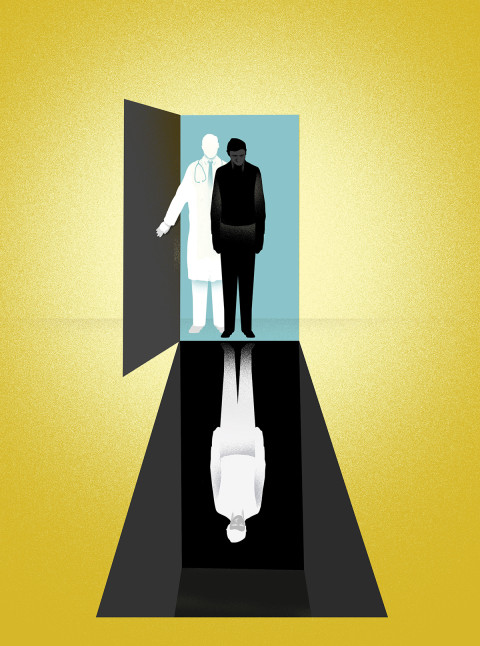
In 2024, in a wooded area in northern Switzerland, an American woman climbed into a sleek-looking capsule, pushed a button, and ended her life. The capsule, called the Sarco, is designed to be a drug-free method of suicide. It allows the operator to release nitrogen gas into the pod, thus lowering the level of oxygen inside to lethal levels and, within minutes, suffocating the person inside.
The Last Resort, the Swiss assisted dying organization which offers the Sarco, says the capsule “represents the future of dying.” And on that Monday afternoon, the future arrived as this 64-year-old American became the first person to use it to end their life.
Read our latest issue or browse back issues.
What leads a person to choose the time and manner of their own death by way of physician-assisted suicide, also called medical aid in dying? This first known user of the Sarco reportedly was severely immunocompromised. Others pursue PAS after being diagnosed with terminal illness or a neurodegenerative disease such as Alzheimer’s, dementia, Parkinson’s, or ALS. We humans tend to see our lives as a story, and naturally we want the story to end well—what psychologist Daniel Kahneman calls the “peak-end effect.” Good endings make for good stories, sometimes even if the story is abbreviated. Some see PAS as a better ending than facing the drawn-out experience of dying from a progressive illness or terminal diagnosis. So when a diagnosis begins to write the story for us, it becomes tempting to seek a pen—or a Sarco pod—to rewrite the ending to our own satisfaction.

Swiss authorities have ruled that the Sarco’s use of nitrogen is not legally compliant and that the capsule does not meet product safety law standards. Yet alternative methods of PAS have long been legal in Switzerland and elsewhere. In the United States, more than 108 million people in 13 states and the District of Columbia currently have access to legal ways of ending their life when facing a terminal illness. Since 1973, a majority of Americans have supported laws allowing doctors to end a patient’s life by painless means if requested by the patient and their family, and a 2024 Gallup poll reports that 71 percent of Americans are now in favor of such laws. Thus, it seems likely that legal protection for PAS will soon expand to more states.
These conversations about how and when to die are happening at kitchen tables, hospital beds, state legislatures, and in New York Times bestsellers, mostly centering on whether and how PAS may be legally available. But as Dutch ethicist Theo Boer wrote a decade ago in the Century, “answering the moral questions is not the same as settling the legal ones” (“Rushing toward death?” April 13, 2016).
When a life-altering diagnosis is given, or when aging is beginning to take its toll, clergy are often called to patients’ bedsides to provide comfort with ministries of presence, prayer, and ritual. In this way, they become part of a larger team of caregivers that includes family, friends, and medical professionals. But clergy are also called to provide guidance to those wrestling with moral decisions related to health care. The high level of support for PAS reveals something about how many Americans understand suffering, autonomy, and dignity in relation to end-of-life care and decisions. And if PAS really is the future of dying, then pastors, chaplains, and other spiritual leaders should be ready to help people of faith consider the moral complexity of the practice.
Suffering
In contrast to previous eras, today death occurs less frequently as a sudden event and more often as a drawn-out series of illnesses that slowly and progressively weakens our bodies and minds. Some individuals, when given the choice between acquiescing to this long, slow march toward natural death or pursuing swift and painless assisted suicide, would prefer the latter. Many of us would consume a prescribed drink or push a button if it promised to alleviate suffering. Does it make a difference if the prescribed drink is a lethal cocktail or if the button is inside a Sarco pod, and the alleviation of suffering hastens our own death?
Dutch law allows doctors to offer assistance in dying, with euthanasia or physician-assisted suicide, to any patient who makes an informed request and who faces unbearable suffering with no hope of improvement. The law does not say what constitutes unbearable suffering and is thus subject to broad interpretation. Regardless, there is virtue in the desire itself to alleviate or end suffering, including our own. Suffering—even if we think it is bearable—should never be desired or willed.
Yet Stanley Hauerwas questions whether suffering can or should always be avoided. “Like many other ‘obvious’ beliefs,” he says, “the assumption that suffering should always be prevented, if analyzed, becomes increasingly less certain or at least involves unanticipated complexity.” To be clear, humans should never desire that someone suffers at the end of life. But expectations and desires are not always met, and how one deals with unmet expectations speaks to the individual’s resilience, fortitude, and faith. Though it never ought to be pursued, suffering is an unavoidable part of life, and sometimes the only option is to endure.
Hauerwas asserts that there is nothing about suffering itself that is redeemable; nonetheless, some suffering can be transformative. One transformative aspect of suffering is its ability to cultivate selflessness. A world without un-patterned and un-purposeful suffering, Hauerwas says, “would be devoid of the means for us to grow out of our selfishness and into love.”
For people who desire PAS due to their unbearable suffering, the limitations brought on by neurodegenerative diseases or terminal illness may instead be an opportunity to grow in selflessness by needing to depend on others for continued existence. Furthermore, declining abilities offer a chance to recognize that worth and dignity as humans is not defined by physical or cognitive capacity, but as beings created in the image and likeness of God.
Autonomy
The primary legal and medical ethical arguments in support of PAS rest on the principle of patient autonomy, defined in two ways. The first is as a negative obligation, best understood as removing constraints and getting out of the way of a person’s self-chosen path, allowing the individual to act freely so long as those actions do not harm others. The second is as a positive obligation, understood as the obligation to fully disclose all information pertinent to making the autonomous decision. Patients of sound mind have the right to make their own medical decisions and to be fully informed of pertinent details.
Requests for PAS flow from a natural desire to retain autonomous control over one’s own life story as it is coming to an end. This desire bears resemblance to what Charles Taylor describes as “self-determining freedom.” By removing all external impositions and moral or relational commitments, he says, the individual is then free to “do their own thing” or “find their own fulfillment” based entirely on self-determined morality. Accordingly, the individual can exercise greater control over their life and narrative without constraint or criticism from external demands of history, tradition, society, nature, or God.
Similar anthropological observations have been made by Robert Bellah, whose notions of utilitarian and expressive individualism describe a moral approach to life in which self-interest becomes the only thing that matters, and by Christian Smith and Melinda Lundquist Denton, whose 2005 study among American youth revealed an understanding of God as “a combination Divine Butler and Cosmic Therapist”—a God who exists to serve humans rather than the other way around. As the youth of Smith and Denton’s study approach middle age, it is not surprising that the importance of personal autonomy factors heavily into public perception of PAS.
Indeed, autonomy often warrants celebration in nonmedical circumstances. Milestones of childhood, adolescence, and early adulthood—first steps, getting a driver’s license, going off to college, buying a home—offer chances to cheer an individual’s growing independence. But at these milestones we seldom consider that, in later years, many of these events are experienced in reverse. The driver’s license and car keys are taken away. Children and neighbors assume responsibility for grocery shopping and home repairs. A chairlift is installed in the stairwell. If we survive long enough, eventually all of life is assisted living, regardless of whether we move into institutions with this purpose.
Likewise, patients of sound mind must be allowed to make their own health-care decisions. Yet even in medical ethics, autonomy is a situated freedom. Personal choices can, and often do, have a social impact. Limitations on patient autonomy already exist. Consider that in almost every nation, it is illegal to sell human organs—even one’s own. This is a necessary limitation of autonomy for the sake of justice, ensuring protection against bad actors harvesting organs from unwilling persons, individuals selling a kidney to the highest bidder, or access to organ transplants depending upon one’s financial means rather than the waiting lists we use to protect fair and equal access. Thus, most governments agree on the need to guard against allowing human organs to be sold.
Part of being human means recognizing that all freedom is necessarily limited by our responsibility for each other. As a relational and social being, each person is dependent upon and vulnerable to the consequences of actions by others; thus individual autonomy is sometimes situated within an ethic of responsibility to one’s community. And though a patient’s autonomy to choose PAS may be legally protected, that does not automatically presume that the choice is moral. Pushing our own death button has a myriad of consequences, foreseen and unforeseen. Strained or broken relationships will no longer have a chance to be mended. Investments in better and more accessible palliative or hospice care may come to be seen as superfluous, a consequence suggested by troubling trends beginning to emerge in the Netherlands. Motivation to find cures or better treatments for cancer, neurodegenerative diseases, and other illnesses may wane. And beliefs about the value and dignity of human life may shift in concerning ways.
Dignity
The first known Sarco death in 2024 was described by the Last Resort as “peaceful, fast, and dignified.” Its speed can be measured, while its degree of peacefulness is fully known only to the patient. But how are we to ascertain what qualifies a death as dignified?
In an age in which self-determination, individualism, and self-interest are glorified and God exists solely to coach us into being our best selves, needing help from another person can often elicit feelings of shame, weakness, or suffering. “We’ve succumbed to a belief that, once you lose your physical independence, a life of worth and freedom is simply not possible,” says physician and writer Atul Gawande. In such a culture PAS becomes a way to retain a life of dignity—one that helps us avoid the pain of a dying process where we become gradually more dependent upon others to care for us.
Many people born with physical or cognitive disabilities or limitations do not have the experience of aging out of, and then back into, dependency on others. For them, having caregivers is simply part of what it means to be to alive. Really, this is true for everyone: to be human is to live on a scale of disability, always subject to the limitations and vulnerabilities of life.
Where PAS is legal in the United States, the patient must be diagnosed with a terminal illness and be expected to die within six months. However, in Canada, Switzerland, and the Netherlands, PAS is decriminalized for nonterminal patients as well—and has been long enough for statistical trends to emerge. In the early years in the Netherlands, about 95 percent of those who chose PAS were mere days or weeks from an expected natural death due to terminal disease. Thirty years later, about 25 percent of patients seek PAS for nonterminal reasons such as dementia, psychiatric illnesses, and age-related complaints.
As access to PAS expands in the United States, this trend should be noted carefully. Most Christian traditions agree on a definition of human dignity that does not rest on a person’s level of physical or cognitive capacities. It is rooted instead in a person’s sacred and inherent worth as created in the image and likeness of God.
Patients with neurodegenerative diseases experience limitations in physical mobility and cognitive or communicative capacity. These limitations typically increase over time, motivating some of these patients to seek PAS to avoid what they see as the indignity of losing memory, mobility, or other forms of independence. Intentionally or not, this perspective risks communicating that a person’s value or worth is based upon their physical or cognitive ability. Consequently, this opens the door to arguments that people with disabilities have less dignity than a young, able-bodied intellectual with few or no physical or cognitive limitations. If being fully human requires complete, nondisabled use of mental and physical faculties, then many people who are disabled by birth, traumatic injury, degenerative disease, or simply the physical and cognitive decline of old age may become categorized as less than fully human.
As Darlene Weaver argues, sometimes honoring human dignity means setting moral limits on the exercise of individual freedom and autonomy. Choosing to live with disability rather than choosing PAS can be a practice of solidarity with the disabled community and can honor the inherent moral worth of each person.
If PAS is the future of dying, how might Christians approach this growing menu of options faithfully?
A patient’s autonomy is primary but seldom absolute. Personal choices have social impact. Even if pushing one’s own death button is morally permissible, the effects on others must first be considered. A patient may thoughtfully consider any continuing relational benefits—with loved ones and with God—that may be missed by hastening death.
Furthermore, death may be embraced as one more aspect of what it means to live. A patient foregoing the option of PAS may still choose to decline potential life-saving treatment, and effective palliative and hospice care can minimize suffering and pain at the end of life while still allowing the patient to die naturally. Meanwhile, patients who do choose PAS might still be encouraged to approach death not as something to control and orchestrate but rather as another part of life to accept and endure. And those who care for them might choose to honor the patient’s autonomous choice while still offering the sort of compassionate community desired at the end of every life.
“This is not the time for a priest to make a moral stand and leave a reeling and confused family out in the cold,” writes Cole Hartin, an Episcopal priest and theologian. “Rather, after having graciously given an account of Christian death, it is the time for pastors to walk alongside those who are ending their own lives, even if this means walking with some distance. . . . The vocation of the pastor in this instance is to be a physical reminder of the judgment and mercy of God.”
A ministry of presence goes up to and includes the point of death, as well as the grief of loved ones afterward. Even—perhaps especially—if a person thinks the patient’s choice of PAS is morally wrong, a ministry of presence as they drink a lethal cocktail or climb into a Sarco reminds them that nothing, not even morally complicated decisions at the end of life, can separate them from God’s love, grace, and forgiveness.
********************
The Century's community engagement editor Jon Mathieu discusses the theology and pastoral considerations for end-of-life decisions regarding physician-assisted suicide (PAS) or medical aid in dying (MAiD) with Erik Hoeke.