Beautiful objects in a sea of inequity and decadence
When I think of Downton Abbey, I think of the costumes



Beautiful objects in a sea of inequity and decadence

“It is not without irony,” says sculptor Gillian Genser, “that the creation of this piece was to be my demise.” When she set out to depict the story of the first man, Adam, Genser sought to reimagine the man who should have been. Not the one given dominion over the earth. Genser reimagined a different starting point: an original person who didn’t subdue but was in “interconnected coexistence with all other life on this planet,” as she writes in her artist’s statement. What would that look like?
white table
stretched reaching
as far
as the eye
can see
grain fields
at the other end
or is it
the head
an hour glass
table man’s
delight
hand upon
hand
up end
end up
Ukrainian
black earth
emptying
wheat to sand
in his putrefied
hand upon
hand
empty
ever emptying
Unable to see verdant forests
for mangled, ecclesial trees,
most of my companions
have abandoned the church,
not rats, but certainly escapees
from a rusty old ship,
with a treasure in her hold
undiminished by its often ugly,
always precarious, commanders.
Particularly drawn to a patch of trees,
steady company, barbed wire closing in,
Grandpa Tzvi and I, a toddler, wandered
Germany’s Wetzlar DP camp, his hand
holding mine in reassurance as we explored
the paths of my lost childhood.
I hugged those trees and left a soft kiss,
gratitude for their consenting murmuring
and sweet aroma. In that German garden
of Eden with Grandpa, I became one
of those trees while biting a ubiquitous apple.
A photo proves it.
Bumbling out of the night,
something veers near the fire,
wings seared swiftly away;
it squirms in the suburbs of the blaze.
Oh, deathwish beetle,
clutzy buzz of immolation,
hard-backed, inadequate Shadrach . . .
When it stills, I place the shell
on the pyre. Another dives, dies,
smashing into a surrounding stone,
writhes and writhes.
Flame-kissed Phyllophaga,
acorn-armored Icarus,
my faithful antiangel . . .
The painter’s Exodus calls to mind the Passover, the Shoah, Ukraine, and the southern border.
What’s the use, little one?
You daily peck the mulch
of summer’s torpor, then
carry a dead blade of grass
up to the birdhouse, where you
disappear into a black hole
the size of my thumb.
A minute later, you do it
all over again, beaking the pile
of bark and old vegetation below
to find just the perfect fragment
of ribbon, sun-dried
in the sparseness of drought.
Altar bare.
No one’s there.
It’s unused.
Where the Word
once was heard:
empty pews.
It lies dark
and was marked
unessential.
Can a screen
ever seem
reverential?
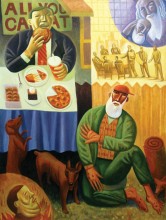
Painting the parables is a special calling for James Janknegt. At the start of the new millennium, the Texas artist took up his brush to create 40 images of the teachings of Christ in what he calls “modern day American vernacular,” one for each day in the season of Lent. He published them in a book of meditations on the parables in 2017. These contemporary variations in paint on the oft-told New Testament tales turn the first-century Middle East into suburban America. A stock character like the builder of bigger barns becomes a real-estate developer.