For more from the Christian Century, click here to sign up for free newsletters.
Buried in the foreword to Project 2025’s “Mandate for Leadership,” the not-quite-disavowed blueprint for the incoming Trump administration, is a strange reference to Dietrich Bonhoeffer. “Open-borders activism,” the document declares, is “a classic example of what the German theologian Dietrich Bonhoeffer called ‘cheap grace.’” Bonhoeffer is then invoked to denounce other excesses of the left, such as environmental extremism and insufficient hostility to China.
It is obscene that an antifascist martyr’s memory is being used to legitimize a movement promising mass deportations, but the American right has long admired Bonhoeffer. Much of this admiration stems less from his theology than from his decision to join a conspiracy to assassinate Adolf Hitler—a decision that ultimately led to his execution in the Flossenbürg concentration camp. This has given rise to the dubious concept of the “Bonhoeffer moment,” a term some use to describe a historical situation in which nonviolence is no longer tenable for a Christian and something like his act of attempted tyrannicide becomes necessary. Bonhoeffer moments are imagined as moments of extraordinary moral clarity, when good and evil are laid bare and previously unjustifiable acts become justified.
Read our latest issue or browse back issues.
It is this image of Bonhoeffer wielding righteous violence against a tyrannical state that has ignited the right’s imagination. In 2011, former VeggieTales writer and current far-right radio host Eric Metaxas’s Bonhoeffer: Pastor, Martyr, Prophet, Spy became a runaway hit and positioned him as a popular interpreter of Bonhoeffer’s legacy (see “Hijacking Bonhoeffer,” October 19, 2010). In 2020, he proclaimed that the allegedly stolen election marked a Bonhoeffer moment and that lethal force was now permissible to keep Donald Trump in power: “What’s right is right,” he said. “We need to fight to the death, to the last blood.”
But Bonhoeffer himself refused to see the plot to assassinate Hitler as morally justified. He insisted that what he was doing, while necessary, was at the same time a grave moral wrong for which he must repent and beg God’s forgiveness. In the hundreds of pages he wrote during his years in the conspiracy, Bonhoeffer adamantly warned that any sense of moral clarity we might feel is always an illusion. If we trick ourselves into thinking that we have full knowledge of good and evil, that we clearly see right and wrong, then we never have to question the moral purity of our actions. Because we are on the side of good against evil, we think that our actions—and our violence—must therefore be good.
This was the heart of Bonhoeffer’s theological critique of fascism: fascism seduces by promising knowledge of good and evil, shrouding its own violence in a fantasy of moral clarity. His greatest act of antifascist resistance is thus not some act of righteous violence but his own steadfast refusal to see even the most necessary and seemingly justifiable violence as a positive moral good.
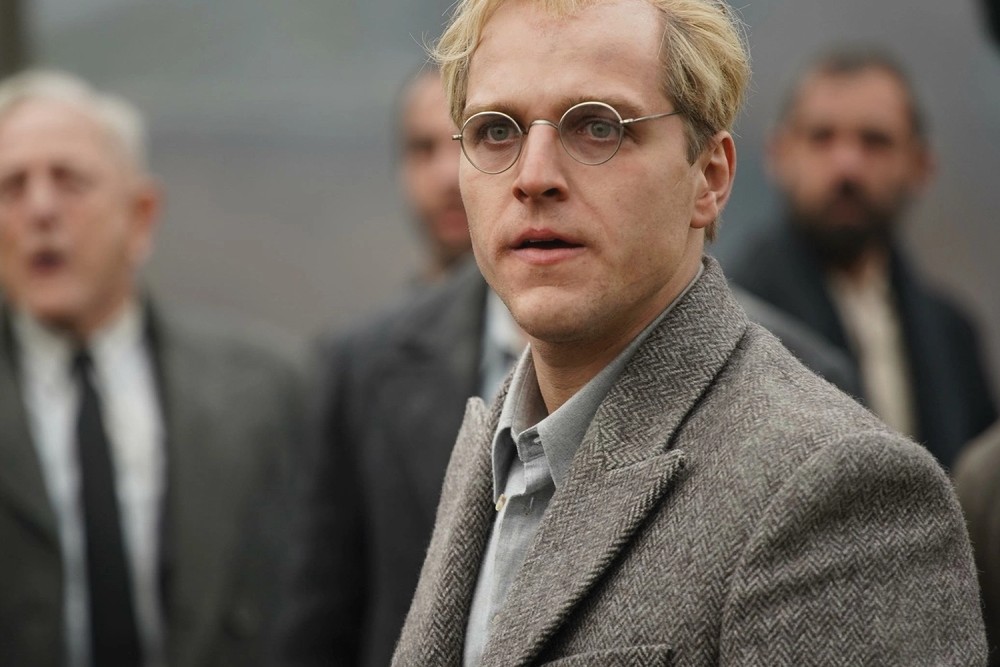
The new movie Bonhoeffer emphasizes similar themes to those of Metaxas’s biography. It situates Bonhoeffer’s story in the familiar genre of the World War II thriller but erases the moral powerlessness and inescapable guilt that haunted him.
The real Bonhoeffer wrote that he felt lost in a “huge masquerade of evil” in which “evil appears in the form of light.” He lamented the uselessness of Christian ethics, which relies on “the abstract notion of an isolated individual who, wielding an absolute criterion of what is good in and of itself, chooses continually and exclusively between this clearly recognized good and an evil recognized with equal clarity.”
Bonhoeffer the movie, on the other hand, presents him as just this kind of moral agent who clearly recognizes good and evil, with the only real question being whether he has the stomach to do what he knows is right. By reducing moral deliberation to a question of will, the movie not only badly misreads Bonhoeffer. It also traffics in the dangerous idea of the Bonhoeffer moment, inviting its viewers to imagine that they, too, can clearly recognize evil tyrants in need of some justified violence.
Nearly every scene mangles and stretches both Bonhoeffer’s life and German history into a pat fable of good versus evil. The real Bonhoeffer’s bit part in the conspiracy to kill Hitler (using his church contacts in England to pass documents negotiating a possible peace treaty in the event the coup was successful, all of which were ignored) is transformed into a starring role, with Movie Bonhoeffer hunched over a table in the back of a bar, whispering about plans to construct a bomb. The real Bonhoeffer’s failure to radicalize German churches against Nazi antisemitism (a failure that informed his understanding of Christian ethics as a dead end) is in the movie a rousing success—the Confessing Church forms as an underground cell of Christian resistance under Bonhoeffer’s command, with one character gushing that “Bonhoeffer and his merry men” have “declared war on Hitler.”
The most egregious misreading of the real Bonhoeffer comes in a scene where he makes the fateful decision to join the conspiracy. His brother-in-law, Hans von Dohnanyi, has just told Bonhoeffer and his student Eberhard Bethge of the secret plan to kill Hitler. Bethge is shocked at the idea of committing murder and tries to talk Bonhoeffer out of it. He reminds Bonhoeffer that he once said Christians must defeat their enemies with the power of love. “That was before Hitler,” Bonhoeffer glowers. Bethge, despondent, asks, “Will God forgive us if we do this?” Bonhoeffer shouts him down: “Will he forgive us if we don’t?!”
The line gets Bonhoeffer’s thinking about the conspiracy exactly backwards. He was tortured by his decision to violate God’s clear and inviolable commandment not to kill. Everyone, without exception, is beloved of God, and killing is, in every situation, wrong. At the same time, it would be wrong to sit idly by as millions were murdered. No matter what he chose, whether he joined the conspiracy or not, he would be guilty. He had to act, he wrote, “in the sphere of relativity, completely shrouded in the twilight that the historical situation casts upon good and evil.” He joined the plot, but he refused to see his decision as morally justifiable. “Here the law is being broken, violated,” he deplored. It might be true that “the commandment is broken out of dire necessity,” but to say he broke the commandment of necessity is still to say he broke the commandment. Rather than pretend this was some positive moral good, Bonhoeffer instead threw himself at God’s feet and begged forgiveness for the sin he could not but commit. The movie has none of this squishy moral agony.
Bonhoeffer is clearly aware of the real Bonhoeffer’s writings on the impossibility of right moral action, but in the film any language of moral ambiguity is simply window dressing on a clear-cut case of good versus evil. Whenever Bonhoeffer does acknowledge the moral messiness of his actions, it’s always in tough-guy quips delivered like Clint Eastwood. When Dohnanyi tells him that the conspiracy will involve getting his hands dirty, Bonhoeffer snaps, “All I have are dirty hands.” And when he’s told he’ll have to swear an oath to Hitler so he can join the Abwehr and travel freely to England, he growls, “Sometimes you have to lie better than the Father of Lies.” Gone is the twilight of good and evil, gone is the diabolical masquerade in which evil appears as light.
This Bonhoeffer is exactly the kind of person the real Bonhoeffer skewered as an “ethical fanatic” who easily falls prey to fascism’s seductions. Ethical fanatics “believe they can face the power of evil with the purity of their will and their principles” but only end up “fall[ing] into the net of their more clever opponent” as their self-conception of being morally pure makes them blind to their own complicity.
I can’t help mentioning that Bonhoeffer not only is based on a far-right propagandist’s spurious biography but is distributed by Angel Studios, which also distributed the QAnon-adjacent thriller Sound of Freedom in 2023. That film dramatizes the life of Tim Ballard, a self-styled crusader against child sex trafficking, whose bizarre claims that he led secret raids into African “baby factories” where children are harvested for Satanic rituals landed him on the first Trump administration’s anti-trafficking advisory board. (Ballard was removed from his organization after being accused by several women of sexual misconduct.) Ballard is played by Jim Caviezel, best known as Jesus in The Passion of the Christ and last seen at a Michael Flynn event at which the general endorsed the idea of a military dictatorship and Caviezel accused Hillary Clinton of consuming adrenochrome harvested from the blood of children.
Sound of Freedom and Bonhoeffer inhabit the same political and moral universe, in which the only moral dilemma is whether the good guys can set aside their squeamishness and start killing the bad guys. For the real Bonhoeffer, this was exactly the fantasy of moral purity that led so many into complicity with fascism’s escalating spiral of violence.
The final scene in Bonhoeffer, based on historically discredited accounts of the man’s death, explicitly invokes the idea of moral purity and extends it vicariously to the viewer. Bonhoeffer stoically marches to the gallows past his fellow prisoners (and the SS man whose heart, Grinch-like, grew three sizes after meeting the saintly pastor). He stands with the noose around his neck and recites the Beatitudes. When he gets to “Blessed are the pure in heart, for they will see God,” the camera cuts to the dappled sunlight shining through the clouds. As in every other scene, this is all text and no subtext: Bonhoeffer is pure of heart, and he has seen God.
But the real Bonhoeffer did not feel himself pure at heart. He felt himself an attempted murderer, wracked by shame and guilt, a moral failure whose only hope was in God’s boundless forgiveness. That his fellow conspirators saw themselves as heroes profoundly disturbed him. “We have been silent witnesses of evil deeds,” he wrote in a document circulated among the conspiracy. “Experience has rendered us suspicious of human beings, and often we have failed to speak to them a true and open word. Unbearable conflicts have worn us down or even made us cynical. Are we still of any use?” The film whitewashes the real Bonhoeffer’s crushing sense of uselessness, offering instead a Bonhoeffer who promises that violence can make us pure.
Project 2025’s invocation of Bonhoeffer to justify a regime of deportation and concentration camps is obviously absurd, but it illustrates the danger of remembering Bonhoeffer more for his decision to kill than for his insistence that no killing, even if absolutely necessary, can ever be justified. A truer way to think of a “Bonhoeffer moment,” instead of a moment when good and evil are laid bare and violence becomes permissible, would be a moment when we are so implicated in structures of evil and violence that right moral action becomes impossible and we cannot but choose wrongly.
In other words, every moment is this kind of Bonhoeffer moment.
This article was edited on November 22, 2024, to (a) correct the erroneous claim that the film Bonhoeffer is adapted from Eric Metaxas’s biography and (b) correctly identify Angel Films as the distributor, not the producer, of both Bonhoeffer and Sound of Freedom.
For more from the Christian Century, click here to sign up for free newsletters.