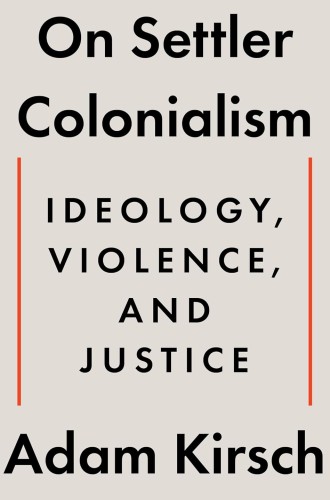
On Settler Colonialism
Ideology, Violence, and Justice
The standard version of colonialism, explains Adam Kirsch in his provocative and important new book, involves a relatively small group of colonists—mostly colonial administrators, merchants, and military personnel—ruling over and oppressing a much larger Indigenous population, usually to extract needed natural resources. An example is the British colonial control of what is now India and Pakistan, where in 1931 a population of 250 million was ruled by a mere 150,000 “European British subjects.” France controlled 23 million Vietnamese with only 40,000 Frenchmen. Similar disparities existed in colonized regions throughout Asia and Africa. In the decades following World War II, successful revolutionary movements drove out their colonial overlords and established independent states. As Kirsch notes, “according to the UN, the number of people living under colonial rule fell from 750 million in 1945 to 2 million in 2020.”
But this was not the only form of colonialism. While some colonizers came to extract needed resources and exploit cheap labor, others came to stay. The latter became known as “settler colonialism,” and its chief examples are the United States, Canada, and Australia. In each case, the colonizers came not simply to extract resources but to establish a new homeland. The Indigenous population was either ruthlessly eliminated, confined to certain areas (reservations), or assimilated through often brutal educational enterprises.
Read our latest issue or browse back issues.
Kirsch suggests that as the theory of settler colonialism developed, what began as a tool to distinguish between forms of colonialism became less of an academic discipline than a religion. The act of colonization became a form of original sin that is inherited by all the heirs of the original colonizers. “Settler, in this view, is not a description of the actions of an individual, but a heritable identity,” Kirsch writes. “In fact, it’s not even necessary to be the lineal descendent of an original dispossessor to qualify as a settler.” So, for example, even the descendants of Africans brought against their will to what became the United States are now considered settlers. Construed this way, settler colonialism, like the sin of Adam and Eve, produced evils that continue to oppress and corrupt the colonized peoples and lands: “Settler colonialism means that the violence involved in a nation’s founding continues to define every aspect of its life, even after centuries—its economic arrangements, environmental practices, gender relations.”
Settler colonialism discourse also has its own eschatology. Kirsch cites Lorenzo Veracini, a scholar of settler colonialism, who writes that every attempt to include, acknowledge, reconcile, and make reparations for colonial sins is a form of “transfer,” and despite such ameliorating efforts “all [settlers] participate in the logic of genocide.” In this view, the only way for settlers to atone for their sins is to leave or die off and return the land to its original inhabitants. And according to the eschatological vision of some critics, this is what will eventually happen. By some unknown means, the settlers will disappear, and the land once more will flourish under the care of its original inhabitants.
Theorists of settler colonialism consider “settler ways of being” responsible for “virtually everything one objects to in modern American life—from selfishness to strip mining to the scientific method,” writes Kirsch. The problem with this, he argues, is that it makes serious political action to address such difficulties impossible. In this view, every desirable outcome in society—economic equality, environmental conservation, sexual liberation, and an end to racism—can only be accomplished by the destruction of “settler ways of being,” which, Kirsch notes, involves the destruction of the settlers themselves. One cannot and evidently should not try to address such evils through communal action, since the community itself is tainted by “settler ways of being.”
Once the monster of settler colonialism is slain, Kirsch writes, the theory is that “all these evils will disappear at the same time.” He continues: “The great appeal of radical ideologies has always been this promise of a final solution.” And such “final solutions” frequently end in violence and always end in disappointment.
Kirsch is not suggesting that there are no evils to be addressed. Far from it. Rather he is arguing that to assert that an abstraction like “settler colonialism” is the key to explain and eventually eliminate those evils is ultimately naive. It is an example of a kind of magical thinking that is unworthy of the seriousness of the ills it seeks to address.
As noted, the primary examples of settler colonialism have been the United States, Canada, and Australia. Today, however, the principal and most reviled example in many realms of discourse is the state of Israel. Kirsch calls this “puzzling on its face.” He points out that the Jews who settled in Palestine did not come from a colonial power who sent them out to secure needed natural resources or open new markets for its goods. Nor did they attempt to destroy the Arab population, however much misery the state has inflicted on it. Kirsch notes that in the years following the Israeli Declaration of Independence in 1948, “the Arab population of historic Palestine more than quintupled.”
A clearer example of settler colonialism in the 21st century, he argues, is China, where Tibetan children have been compelled to attend residential schools “aimed at assimilating Tibetan people.” The misery of the Uighur people is also well known: “Since 2017 more than a million Muslim Uighurs have been detained in what the Chinese government calls vocational training centers.” Others call them reeducation camps.
None of this is to excuse the mistreatment of Palestinians in Israel and the occupied territories (the latter of which Kirsch does not discuss) or the tragic number of civilian deaths in the current war. It is rather to suggest that the concept of “settler colonialism” is the wrong tool to critique Israel’s policies and practices—and that it could have tragic consequences for both Palestinians and Jews.
Israel is the one place in the world where the aims of those who wish to eradicate what they characterize as settler colonialism could plausibly be realized. To imagine that one could drive out the entire European settler population from the United States, Canada, or Australia stretches the credulity of even the most dedicated advocate of the theory of settler colonialism. This can only be dreamed of in some distant millennium when the Indigenous population recovers the land from the ashes of civilizational collapse and restores their way of life as if nothing had happened. But Israel is different. One can imagine all the Jews killed or driven out.
Here the colonial model fails as a tool to understand Israel and its history. When the French were driven from Algeria, the large French settler population could return to France. When the British colonial powers were thrown out of Africa and Asia, the British could return to Great Britain. For the Jews of Israel, there is no native land to return to. For Israel’s Jews, Israel is their native land. Many of them went there to flee lands in which they were not considered native. And it is hard to imagine any European country today—or, for that matter, the United States—absorbing 7 million Israeli Jews. They are likely to be as reluctant to take in such large numbers of additional Jews as they were during the Second World War.
This is especially poignant to consider today, when Jews in Europe are, as in the past, fleeing Europe for Israel. When Jews hear, “Palestine will be free, from the river to the sea!” many of them hear, “All the Jews must die.” The October 7, 2023, attack seemed to many a precursor to an even greater slaughter.
The religious character of the concept of settler colonialism means that any attempt through political processes to establish a just society where Jews and Palestinians live together in peace is a heresy. If the only possibility for justice entails the destruction of one people or the other, such justice is a murderous illusion. The irony of Israel is that according to the theology of settler colonialism, the Jews’ return to sovereignty in their ancient homeland after being driven out by the Romans (among others) is an example of an Indigenous people returning to and reclaiming its homeland.
And this illustrates the problem of the theory. When the Jews returned to their homeland, they found that another people, by long occupation and deep love, also considered it their homeland. As the distinguished Israeli journalist Yossi Klein Halevi has said, there are two narratives in Israel/Palestine. They are contradictory—but they are both true. Until both the Jews and Palestinians fully reckon with this fact, no solution that does not involve genocide is possible. The past, Kirsch points out, cannot be undone. In fact, “despair over the past is what makes it possible to hope for a better future, instead of perpetuating grievances and blood feuds.” Drawing on the work of French sociologist Maxime Rodinson, Kirsch continues:
It is a sign of ignorance to turn any country into a symbol of evil, but in the case of [the United States and Israel], it is also a sign of ideological malice. And ideologues who “preach vengeance and murder from an ivory tower,” in Rodinson’s words, should be rebuked for their inhumanity, not praised for their idealism.
The intellectual rigor, despair, and hope of this short book make an essential contribution to a debased conversation. I trust it will help redirect this conversation from outrage and despair to compassion and justice for the tormented people of Israel/Palestine.