To receive these posts by email each Monday, sign up.
For more commentary on this week's readings, see the Reflections on the Lectionary page. For full-text access to all articles, subscribe to the Century.


To receive these posts by email each Monday, sign up.
For more commentary on this week's readings, see the Reflections on the Lectionary page. For full-text access to all articles, subscribe to the Century.
There are not all that many named women in the Gospels. If asked to come up with a list, we might start with Mary the mother of Jesus and Mary Magdalene; before long we would get to Mary and Martha, the subjects of this week’s reading from Luke. This is one of those stories that provokes howls of rage from some readers. Like the parable of the prodigal son, it can trip our “That’s not fair!” switch. It’s easy to see how the good Samaritan can be the model for our behavior. The Mary and Martha story prickles us more.

Prayer is ministry, and ministry is prayer.
Galatians 3 does not sound like something that could be constrained by pragmatism elsewhere.
In the Gospel reading for this week, Luke gives us one of the stories that even non-Christians are likely to have heard before: the parable of the good Samaritan. Those of us who go to church have likely heard it regularly, and this repetition should tell us how important it is to love our neighbor. But hearing the story regularly also makes it easy to lose sight of this message.
Paul encourages his readers to trust an outcome they cannot yet see.

I want to be like Lizzo when I grow up.
Precision and beauty have kissed.
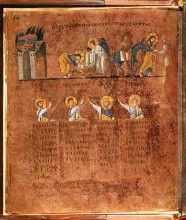
The sixth-century Codex Rossanensis is one of several “purple codices” written on expensive, purple-dyed vellum. It is possibly the oldest extant illuminated manuscript of the New Testament, containing Matthew and most of Mark. The Rossano Gospels include a cycle of miniatures that are sequentially arranged according to lectionary readings. The scene depicting the parable of the Good Samaritan in the upper register (with the four evangelists below) is read from left to right, beginning with the city of Jerusalem.
As a newly minted community organizer, I often find myself wondering what this role should cost me. Organizing is work that somehow manages to be demanding and forgiving at the same time. It is laden with losses and yet invigorating. It pulls out of me a fierceness and a drive to fight for a world where I won’t have to fight anymore—where I won’t have to push and claw for the justice and freedom due to every human.