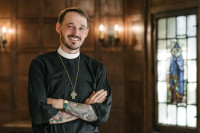
As Immigrations and Customs Enforcement’s campaign of dehumanization continues to strike our neighborhoods, I have been wrestling with what the appropriate response should be from the church. There have been countless sermons preached and statements promulgated, but there still remains one tool with power that has not yet been collectively pursued. Are we now in a status confessionis moment?
I don’t take such a stance lightly, as determining an issue to be status confessionis is a serious undertaking. Status confessionis is a Lutheran theological concept with roots in the 16th century that declares an issue to be a core part of the Gospel, so that remaining neutral on it isn’t an option. Either one confesses, or one does not, and this confession forms the basis of one’s membership in the church. The rising totalitarianism and the cruelty that we are witnessing from ICE are at odds with our faith, and we ought to be clear about that—status confessionis is one way to be so.
Those early modern Lutherans were clear that in normal times, matters not directly pertaining to the Gospel were adiaphora (indifferent things) and could vary from place to place. However, in times of great upheaval, the church was called upon to confess Jesus’ lordship even if it went against the authorities.
In 1933, Dietrich Bonhoeffer picked up this strand of theological reasoning, using it to lay the foundation for the Confessing Church’s fight against the pro-Nazi German Christian movement. His positioning of Aryan race laws not as a mere political disagreement (adiaphora) is indebted to his Lutheran forebears. For Bonhoeffer and his allies, the central confession of Christ’s lordship was bound up in its rejection of the racial ideologies of Nazi Germany, and it required direct action. As Bonhoeffer puts it in “The Church and the Jewish Question,” there are times when it is important not just “to bandage the wounds of victims beneath the wheels of injustice, but to jam a spoke into the wheel itself.” Such a scenario does not present itself when the state is merely failing in its duties, but when it “has created either too much or too little law and order” and thereby either directly persecutes a group of people or allows it to happen.
Later, churches would use the term to oppose Apartheid in South Africa. In 1977, The Lutheran World Federation promulgated “Resolution on Southern Africa: Confessional Integrity”:
Under normal circumstances Christians may have different opinions in political questions. However, political and social systems may become so perverted and oppressive that it is consistent with the confession to reject them and to work for changes. We especially appeal to our white member churches in southern Africa to recognize that the situation in southern Africa constitutes a status confessionis. This means that, on the basis of faith and in order to manifest the unity of the church, churches would publicly and unequivocally reject the existing apartheid system.
Likewise, in 1982, Dutch Reformed Christians in South Africa wrote the Belhar Declaration in Afrikaans, which names apartheid as a status confessionis issue and argues that opposition to it is submission to Jesus Christ: “We believe that, in obedience to Jesus Christ, its only head, the church is called to confess and to do all these things, even though the authorities and human laws might forbid them and punishment and suffering be the consequence.”
The term has even been used to make a claim against the neoliberal order from a faith-based perspective, with the World Alliance of Reformed Churches declaring in its 1995 Kitwe Declaration:
It is our painful conclusion that the African reality of poverty caused by an unjust economic world order has gone beyond an ethical problem and become a theological one. It now constitutes a status confessionis. The gospel to the poor is at stake in the very mechanism of the global economy today.
I take great courage from these examples. They show that while status confessionis is nimble enough to apply to a variety of circumstances, it carries with it a strong sense that the most pressing moral issues of our day demand confession from the church, even when it puts that church in conflict with political authorities, other Christians, and society as a whole.
I think we have reached a moment when confession is required. Perhaps I am biased; the one thing that people know me for is my relentless pursuit to shut down the ICE Processing Center in Broadview, IL. It is easy for me to say that this is a status confessionis moment, but I imagine for many others it will not be so simple to see what appears to be a political issue as a spiritual one. There are already so few big-tent denominations left in existence in the United States. Why divide them even more?
For me, status confessionis is not about calling people out or splitting communions. It’s not about creating more division. It’s about saying precisely what matters to the church in this moment; it’s about naming that the dehumanization has reached such a scale that we are no longer in normal times. It’s hard to quantify the spiritual trauma that takes place when ICE enforcement strikes your community. What do you do when ICE operates a torture center in your backyward, where people are denied food, medicine, and clean conditions? ICE has killed 46 people in custody since the start of the Trump administration, many of them through the sheer unforgivable cruelty of denying them medication. As of February of this year, more than 68,000 individuals were detained in ICE facilities, some of whom were created specifically to torture them, like Alligator Alcatraz. We can’t even locate hundreds of those who were detained there; they have simply disappeared.
The lives of immigrants in this country are sacred to God, and the church cannot stand idly by and witness the cruelty that ICE is perpetuating. We must do the only thing that the church can do in such times: We must confess.
What I see when I look at the long history of status confessionis is that fighting for the dignity of people is not separate from acknowledging Christ’s lordship. If we fail to fight for the children of God, then we cannot fully acknowledge Jesus Christ as Lord. The two are bound up with one another. In times of great upheaval and moral import, we are called upon to confess that central fact explicitly—not as a peripheral concern, but as the heart of the Gospel.
The Church’s confession cannot be mere words. The words are important, but we are past that now. We have to refuse neutrality and align our life—our worship, our resources, our very nature—with those who are bearing the brunt of this administration’s dehumanization. That process starts with a declaration like we have seen throughout history, but just like in the case of Nazi Germany or apartheid South Africa, it leads inexorably towards action, as the church clarifies its values and sharpens its confession.
This may require separating ourselves from those who cannot bring themselves to see this moment as necessitating radical action. That will certainly be painful, especially for progressive religious organizations, who have not taken such steps in recent memory. But I think we can see from the fact that we have so few big-tent denominations remaining due to disagreements about queer peoples’ place in the church that we have the capacity to make difficult decisions, especially when the dignity of human beings is at stake. Regardless, such breaks will be difficult, and ought to be sorted out based on a community’s context and its commitments.
The alignment of our entire institutions with our confession will look differently depending on context. Perhaps it leads to the practices of sanctuary that are springing up across this country, as houses of worship consider just how they might respond to the threat of ICE. I currently lead a sanctuary church that houses a family and has been prepared to act swiftly if ICE returns to Chicago. Others might choose protest or legal advocacy, and still others might radically change their worship to be in solidarity with our immigrant siblings. All are valid expressions of a much needed confession.
Right now, the question is not whether we believe the right thing about immigration policy, but whether we will confess that Jesus Christ is Lord, no matter the cost. If we are indeed in a status confessionis moment, the path is clear, even if it is not easy. It was not easy for any of the groups that made the church’s response to human suffering central to their mission. As Christians, we must seek after what Bonhoeffer called “costly grace.” We must confess.