In Review
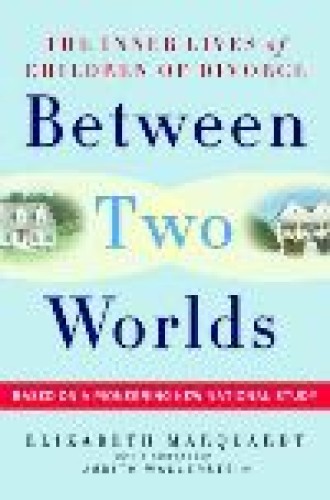
Between Two Worlds: The Inner Lives of Children of Divorce
Elizabeth Marquardt’s book sat on my shelf for many weeks. I really wanted to read it. I had heard about her research and had been intrigued. Yet I kept avoiding actually opening the book. It does not take a shrink to tell me I was avoiding it because I didn’t want to take a look into this particular mirror.
My parents divorced when I was in grammar school, and I sometimes feel I have spent my adulthood defensively living out an alternative to gloomy predictions about the myriad ways divorce harms kids. I think I turned out just fine, thank you. And if you dare suggest that I am an overachiever because I am trying to make up for something I didn’t have in childhood, I will snap your head off before you get a sentence out.
Indeed, sometimes I feel so defensive about my childhood that I find myself refusing to admit that my parents’ divorce had any impact on me whatsoever.
I hesitate to speak about how the divorce affected me for a variety of reasons. First, it seems like Oprah-esque, therapeutic whining; I am well aware that I grew up with many advantages, and it seems ridiculous and ungrateful to natter on about my “broken home” when lots of folks had it a good deal worse. Second, I have never wanted to talk to either of my parents about my occasional, fleeting insights into the ways their divorce shaped me; I prefer to maintain the polite fiction that all was always well, that everyone did the best he or she could, that there is no place in our family story for blame or regret, let alone repentance. Finally, I bristle when someone tries to explain everything in my life—starting with my religious peregrinations—as a reaction to the divorce. I am so determined not to have my autobiography reduced to postdivorce acting-out that I often find myself at another absurd extreme, an extreme in which parents’ choices have no impact on their kids whatsoever, an extreme in which I am exactly the person I would have been had I been born to June and Ward Cleaver.
I know my defenses are ridiculous and false, not to mention prideful. When I can clear my head, when it is just God and me or my journal and me, I can admit the obvious: that yes, of course, even in the most amicable divorce, even when parents don’t turn their kids into chess pieces, even when divorce does not spell economic disaster for the custodial mom, even then divorce indelibly marks children.
When I finally sat down with Marquardt’s book I found that although I didn’t see myself in every page, an awful lot of what she had to say resonated. I even learned that my very defensiveness is typical of children whose parents have divorced.
Between Two Worlds is the fruit of a three-year, Lilly Endowment– funded study, the Project on the Moral and Spiritual Lives of Children of Divorce, which Marquardt codirected with sociologist Norval Glenn of the University of Texas at Austin. Marquardt is interested principally not in the obvious damage that divorce inflicts on some kids—those kids who never manage to graduate from high school, who get addicted to meth, and who have unavoidable, debilitating emotional scars. Her focus is the sadness that lurks beneath the success of even the most highly functioning children of parents who divorced. (I realize that “children of parents who divorced” is a bit clunky, but I have always hated the phrase “children of divorce.” I am not a child of divorce. I am the child of two people who, among other things, got divorced.) Marquardt’s point is that even kids who grow up to be “successful” suffer enduring consequences from their parents’ divorce.
Two-thirds of people who grew up with married parents “strongly agree” that “children were at the center of my family,” whereas only one-third of people whose parents divorced say the same.
Children with divorced parents are far more likely to be physically or sexually abused than children whose parents aren’t divorced. As adults, they are far more likely to say that as children they felt physically unsafe.
If your parents are divorced, you are more likely, when asked about your ideas of home, to talk about your “stuff,” your possessions. You might recall coming home after mom or dad moved out and finding a bunch of your stuff gone. Or you’ll talk about schlepping stuff back and forth from one parent’s house to the other. Or you’ll say you never really felt at home at one parent’s house because most of your stuff was at the other parent’s.
After living through a divorce, children are more likely to feel morally adrift, to become what Marquardt terms “moral forgers,” people who both forge their “own values and beliefs” in the “intense heat” of their inner life and are forced to cut their own path “through the forest of contradictions between parents’ ways of living.” Unlikely to receive strong moral instruction from parents—not because divorced people are immoral, but because divorced people are less likely to be able to agree upon and form their kids in a single, shared vision of the world—kids with divorced parents tend to be less religious than people who grew up with married parents. Though people whose parents divorced “feel just as spiritual as people from intact families,” they are less likely to think of institutional religion as “relevant.” Yet, intriguingly, if your parents are divorced you might wind up more religious than your parents, because you tend to look toward a faith tradition for moral or spiritual guidance you did not get at home.
And finally, one quirky but telling finding: kids whose parents are divorced typically make a bigger deal out of their parents’ birthdays, especially their mothers’ birthdays, than do kids whose parents are married. That seemingly small detail is incredibly revealing—it captures the ways that children whose parents are divorced have to assume adult responsibilities, even the role of pseudospouse, with their parents. There’s something all-around sad about the picture of little Susie working hard to remember her mom’s birthday, saving her whole allowance for weeks to buy her a pair of earrings and a cupcake, and then singing solo, though with great gusto, when presenting said cupcake to mom. Susie shouldn’t have to do all this herself—dad should be there to take charge of the celebration.
Contemporary America, says Marquardt, has embraced the myth of the “good divorce.” While obviously an amicable divorce is preferable to an embittered one, even children of “good divorces” experience more stress, more loneliness and more confusion than children whose parents are married, and even children of “good divorces” are forced to become mature and independent far earlier in their childhoods than other kids. “The stories of children of divorce,” writes Marquardt, “show that it is wrong and misleading to describe our experience as ‘good.’”
The point of Between Two Worlds is neither to heap guilt upon divorced people nor to insist that no one should ever get divorced. “Divorce is a vital option for ending very bad marriages,” she writes. Rather, Marquardt says that we need to stop fooling ourselves about the toll divorce takes on kids. It may make divorcing parents feel better to insist that as long as they divorce without a protracted, ugly custody battle, the kids will be unscathed. That idea may soothe all of us who are complicit in a culture that generally condones divorce. But this self-deluding palaver about “good divorces” harms children. If Marquardt’s book is unlikely to single-handedly stem the tide of divorce, it will at least force us to be honest about the effects of divorce on kids—and knowing more about what children are living through, perhaps we can do more to help.