

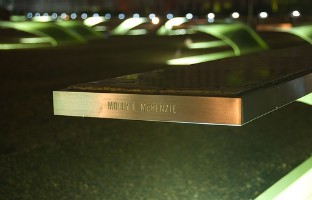
A bench at the Pentagon 9/11 memorial.
Some rights reserved by Mark Fischer.
The smaller gathering across the Potomac
There’s no doubt that Osama bin Laden had been living on borrowed time ever since 9/11 rendered him America's public enemy number one. For those of us who were still in middle school at the time, our history has been color-coded with security threat levels. The student deluge that inundated Pennsylvania Avenue from midnight to dawn after Obama's announcement yesterday demonstrated a powerful ethos of that generation--some would call it justified, others vindictive.
Still, the impromptu singing of "Ding, Dong, Osama is dead" likely seemed immature and triumphalist to the solemn 15 or so gathered just across the river outside the Pentagon. To this smaller crowd, the news provided the closure owed to those who lost their lives ten years ago, not just a beer-spilling opportunity to celebrate the killing of a killer.
But the difference between the two sentiments doesn’t simply illustrate two ways of dealing with the same emotions. It indicates that each group heard a very different message in Obama's address.
One group heard the success story of a U.S. military operation, of murder justified by murder and of a resume builder for a president often painted as weak and overly apologetic for U.S. foreign policy. This politically minded group included people like Richard Indoe, an Ohio farmer present at the celebration, who lamented that this "accomplishment...didn't happen during George W. Bush's time."
The other group, however, heard the story of death for death, true brokenness and the hideous distortion of the image of God in humanity. That’s nothing to celebrate.
If our actions are aimed at the glory of God, we can’t view last night’s events simply as an American victory. Bin Laden’s death approximates only a fallen sense of justice. And the actions committed in pursuit of earthly justice are among those for which Christ bled.
I think the sober few gathered across the river had a clearer understanding of the implicit message in last night's news--one that wept for the cruel irony of earthly justice but also for our failure to recognize its falling short.


Join the Conversation
Comments
On Media, Osama and Death- an incomplete comment in three parts
As a person who doesn't own a TV and largely gets access to my news through newspapers online, it was only late this evening, checking on facebook that I saw commentary upon commentary on the reaction of Americans' to Osama's death. It strikes me as indicative of the effect of social media and televised media that quickly the discussion moved from commentary on the events that occured in Pakistan, to commentary on the commentary of events. With news making the news, I can imagine it is hard for critical reflection, and personal reflection to keep up with the desire to react quickly. Soon the social media news streams were filled with darts aimed at those whose emotions were deemed ill appropriate. Darts of quick and sharp criticism oddly filled with MLK jr, Ghandi, Jesus and more.
I think your article has well articulated, however, the force of Osama's death. For many Americans, the world has changed again, as a man who occupied for many Americans a larger space in their media lives rather than their imminent lives was killed. This is a man who has been portrayed as more than the face of terrorism, but as the face of fear and terror. He was the face that we held responsible for the two towers and the face that served as a catalyst for a war. His face was also linked to Iraq, helping justify a second war. The death of this face can't hold the gravity of the death of any human being, as it is the death of a monster, an idea, a villian. There are others, however, for whom this death serves as but a cold reminder of the many lives already lost, and the families already split. “Death for death” as you put it. Perhaps worse, death provoking the reliving of other deaths, probably not for the last time.
I wish that his death could serve as closure. Our country in its anger has long swelled beyond the bounds of the death of one man being able to heal the wounds of the past. I fear the death of this one image, while leading to celebration for some now, criticism of that celebration by others, eventually leads to that absurd wonder: why is the world still so wrong. I wonder if this country has lost the resources to really answer that question well, particularly when we hide our bloody, oil covered, money filled hands so well.