We need a movement to combat climate change, we need it fast, and we need it to involve as many churches as possible. And you can help make it happen the Saturday after Easter.
How's that for a blunt and artless beginning? But that's the point. The time is so short, and the task so large, that eloquence seems almost frivolous. I wrote the first book about global warming for a general audience way back in 1989, and I've been writing about it ever since. But nowthough I'm not very good at itI'm trying to organize. And I need help. Here's why.
The climate crisis is bearing down on us much faster than most people realize. A decade ago most experts thought of global warming as the largest challenge civilization facedbut they also thought that it would happen relatively gradually. So far, by burning coal and gas and oil, we've released enough carbon dioxide to raise the temperature of the planet about a degree Fahrenheit. Which doesn't sound like much, and indeed the early computer models predicted that such an increase would just bring us to the threshold of noticeable changereally big impacts seemed still a few decades down the road. But that cautious optimism has faded in the past few years as one study after another has proved that the earth was more finely balanced than we'd understood.
For instance, the temperature rise has been enough to start melting every frozen thing on earth, which in turn creates its own problems. In the Arctic Ocean, nice white ice that reflected lots of the sun's rays back to space is quickly turning into nice blue water that absorbs much more of the sun's heat, amplifying the warming. The thawing tundra is releasing huge quantities of methane, which is another potent global warming gas. Scariest of all, the great ice sheets above Greenland and the West Antarctic appear to be melting faster than predicted. There's the very real chance of a catastrophic rise in sea level, one that would endanger the world's coastal cities, inundate much prime farmland, and drive hundreds of millions from their homes.
The bottom line: we have much less time to act than we thought, and that action has to be dramatic. James Hansen is the country's foremost climatologist, a man who will doubtless win the Nobel Prize for his decades as a NASA researcher running the most powerful computer model of the climate, and he said last year that we have a decade to reverse the flow of carbon into the atmosphere or else we will livehis wordson a "totally different planet." There's enough theology in that phrase for a month of sermons, but let me concentrate on the politics. It means that the changes we make in our homes and churches as individuals and congregations, vital as they are, can't deliver the speed or magnitude of change that will slow climate change. It means that we need to change light bulbsbut we also need to change laws. It means that Washington, after two decades of a very successful bipartisan effort to do nothing, needs to spin on a dime.
It would be easier, nicer and in many ways more reasonable to put in effect the kind of tepid and gradual program envisioned a few years ago by politicians like John McCain. But "politically realistic" turns out, with what we now know, to be scientifically unrealistic. By Hansen's calculation, and that of many other scientists, we need to be reducing carbon emissions more than 2 percent a year in this country to have any chance of staying on the right side of catastrophe. We needat the very leasta federal commitment to cut carbon emissions 80 percent by 2050.
That's a hard target, but by no means an impossible one. New technologies are steadily appearingsecond- and third-generation solar and wind systems, ever-better hybrid cars. We understand how to make appliances far more efficient than the ones we use today, and how to change building codes so that new construction stops wasting energy and indeed begins to produce it. And, of course, we know how to build trains and buses, how to grow some of our food closer to home. We don't lack for science or engineering, nor indeed for economic mechanisms to make a transition more efficient, or policy proposals to guide our work. What we lack is simply political will.
Imagine your average representative or senator. He or she hears constantly from the lobbyists representing the most profitable interests on earth (Exxon Mobil, for instance, last year made more money than any corporation in the history of corporations, and it used some of that revenue both to lobby and to spread disinformation about global warming.) The congressperson may also hear occasionally from the lobbyists for the Washington environmental groups, but he suspects that most of the people in his home district don't consider climate change a top priority. I sat in John McCain's office three years ago, when he was trying, without success, to pass his extremely modest billa bill that would not begin to meet the scientific test for taking climate seriously. Still, he said, "all of the manufacturing sector is opposed to significant measures being taken. People like the National Association of Manufacturers, the automobile industry. There's a broad array of powerful opposition to doing anything." There was no great mystery about what needed to happen: "Until enough citizens who are voters care, then these special interests will be able to block any meaningful policy change. It's as simple as that."
So we needand quicklya movement. We need a movement as urgent, as morally committed, as willing to sacrifice, as creative, as passionate as the civil rights movement was a generation ago. And we have to build it almost from scratch. The environmentalism of the moment is vibrant and wonderfulbut it's built for other tasks. It's built for acting on the local level (saving watersheds and scenic views) and for lobbying on the national level (changing toxics regulations or winning new wildernesses.) It's not built for mobilizing masses of Americans around a moral challenge. The possibility of a movement existsHurricane Katrina blew open the door, and Al Gore walked through that door with his powerful movie, An Inconvenient Truth. The national mood has changed, but so far national policy hasn't shifted. And it won't shift enough without a powerful shove.
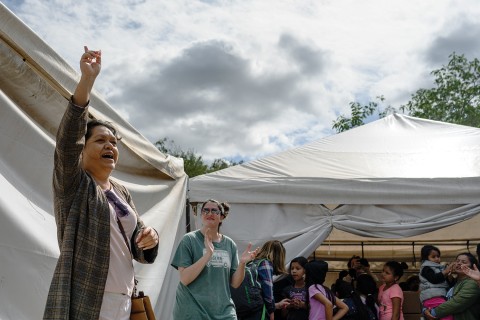
So here's the plan. On Saturday, April 14, a coalition of environmental activists and organizations will be staging rallies around the country. Local rallies will all hoist the same banner: "Congress: Stop Global Warming. Cut Carbon 80% by 2050." Those rallies will be linked electronically, through both the new technologies of the Web and the traditional media. (Only ten days after the Stepitup07 Web site was launched, 196 actions were scheduled in 43 states.) Some of the rallies will be in places everyone will recognizethe melting icefields at Glacier National Park, the levees above New Orleans' Ninth Ward, the endangered coral reefs off Maui and Key West. Some rallies will be in places less famous but equally iconic and special for those involved. Town parks, League of Women Voters meetings, City Hall plazas. Church steps.
Why church steps? Because, to put it crudely, politicians pay attention to people on church steps.
But why should churchpeople be at the forefront of this movement? Here's my best shot at explaining:
1) If you care about social justice, this is the biggest battle we've ever faced. Computer models suggest that climate change will soon be creating hundreds of millions of refugees, fleeing rising waters or fields turned to desert (more refugees than we managed to create with all the bloody wars of the century we've just come through). I've wandered the lowlands of Bangladesh, fertile homeland for 150 million people. Imagining it underwater is ghastly enough. And then remembering that these people have done nothing to create the problem, that the 4 percent of the world living in America creates 25 percent of the carbon dioxidewell, suffice it to say, it makes me feel sad and angry and guilty all at once. And determined, which is the most useful emotion on that list.
2) If you care about the rest of God's creation, then get to work. God made (in whatever way) the creatures of the earth and of the sea; we're now engaged in a massive, rapid act of decreation. Coral reefs may be gone soon, and with them an entire corner of God's brain. Huge amounts of DNA are simply disappearingthe best predictions say that the extinctions from a rapid warming will rival those that happened the last time an asteroid slammed into the planet. Except that this time the asteroid is us, andblessed with free willwe can prevent its impact if we so choose.
3) If you care about the futureabout 10,000 generations yet unbornthen this is your cause. The residence time of carbon in the atmosphere is long, and the changes we're now causing are, on human time scales, probably permanent. It's hard to see what's going to freeze Greenland once we've melted it. We are permanently degrading and impoverishing the earth for all who follow usand we're doing all that to prolong for another quarter century the lifestyle that a fifth of humanity has enjoyed for maybe 50 years.
4) If you care about the selfish individualism that has come to define too much of our culture, then this is the chance to act. This movement is the first in which people will be demanding something more than simply extending participation in "the good life" to more people. It's a movement that will force us to answer deep questions about what that good life is. Eighty percent less fossil fuel use means a different America by mid-centuryperhaps one where people depend more on their neighbors than they do now. That's scary, but also hopeful. The churchwhich can still posit some goal for human life other than accumulationmust be involved in the search for what comes next.
Christians won't be alone in this movement. The nascent religious environmental movementwhich already includes noble efforts like Interfaith Power and Light and the Evangelical Environmental Networkhas found allies in Judaism, in Islam, in Buddhism and in many other traditions (which makes sense, since this issue inevitably involves questions of origin, of end, of right behavior; it's theological at its core). There's also a swiftly emerging student movement on hundreds of campusesnot angry this time so much as dogged and hard-working. Some enlightened corporate chieftains have begun to join in as wellthey know that the insurance sector, the part of our economy that we ask to deal with risk, is (to use the technical term) freaking out over global warming. The November elections removed from power congressional committee chairs who called climate change a hoaxbut in so doing they probably opened the door to the kinds of too-weak compromise that might keep us from doing what we need to do.
Which is: set a target and get to work. Reams can and will be written about precisely what technologies and what taxes and what subsidies and what regulations will and won't be needed in the years ahead. But without a vision the effort will perish, and with it the blooming, buzzing, mysterious, gorgeous, cruel world we were given.
Even with a vision there's no guarantee of success. Some scientists are already saying we've waited too long, that a runaway greenhouse effect is now a real possibility. And the fact that China and India are now starting to burn fossil fuel in appreciable (if not American) quantities makes the task harder (and the need for our leadership all the greater). But faith in a living God allows us hope. Not hope that everything will come out OK, that God will simply override our reckless greed and keep the temperature down. That's not hope, that's wishing. But hope that if we make a real effort, the best effort we're capable of, it will matter. Somehow.
Bill McKibben is the author of The End of Nature, as well as a dozen other books on the environment, and the cofounder of 350.org, a global grassroots campaign to demand action on climate change.